
By BREANNA HOY
Tiger Media Network
A groundbreaking attorney, an Indigenous woman challenging the legal system, and a fight to protect her ancestors’ burial grounds: Lyda Conley’s story is one of perseverance, family history, and the importance of preserving Indigenous heritage.
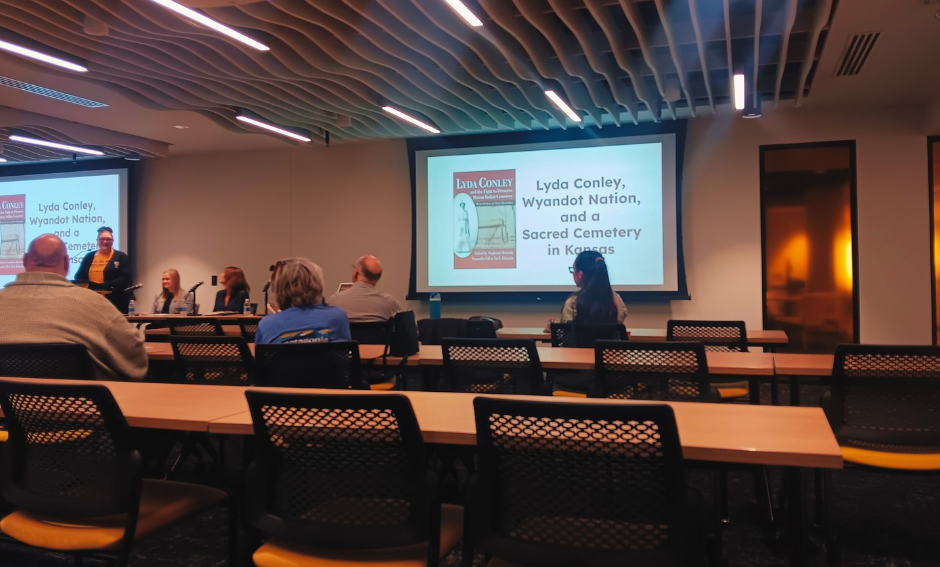
During an author talk at the Tebo Library on Fort Hays State University’s campus, three contributors came together to discuss Conley’s life and her efforts to protect the Huron Indian Cemetery in Kansas City, Kansas. The presentation featured Tai S. Edwards, professor of history and director of the Kansas Studies Institute at Johnson County Community College; Stephanie Bennett, a citizen of the Wyandotte Nation of Kansas who has worked to preserve the cemetery since the 1980s; and Samantha Gill, adult services manager at the Hays Public Library.


Lyda Conley made history in 1920 as the first Indigenous woman to argue a case before the United States Supreme Court. Despite this milestone, her story had received relatively little attention in historical publications.
For Gill, that lack of recognition was one of the reasons she began researching Conley. Gill first became interested in Conley’s story around 2014 while pursuing her history degree at FHSU. She wanted to research a Kansas woman who had made an impact in history, particularly someone who had worked as an attorney. As she continued researching, she realized how little had been written about Conley.
“There’s not a ton on her,” Gill said. “I chose that as an opportunity to make sure that her story was a lot better known.”
Bennett joined the project as an editor, bringing her knowledge of the Wyandotte Nation and her experience in preserving the Huron Indian Cemetery. Edwards contributed her academic and publishing experience. Together, the three combined their expertise to tell Conley’s story through photographs, maps, oral histories, newspaper articles and historical documents.
The history of Lyda Conley is closely tied to the forced removal of the Wyandotte Nation from their homeland. Following the Indian Removal Act of 1830, the Wyandotte were among the last Native nations relocated west. In 1843, approximately 647 Wyandotte people traveled from Ohio to Kansas. After arriving, they purchased land from the Delaware Nation and established a community near present-day Kansas City. They also selected higher ground for a cemetery, which became known as the Huron Indian Cemetery.
The cemetery later became central to the Conley sisters’ efforts to protect Wyandotte history and preserve their ancestors’ burial sites.
As settlement expanded in Kansas, the Wyandotte faced growing pressure to give up their land. Under an 1855 treaty, members could remain in Kansas and accept individual land allotments and U.S. citizenship or relocate to Indian Territory, now Oklahoma. The treaty also included a provision that the Huron Indian Cemetery would be maintained permanently as a burial ground.
Despite that agreement, the cemetery and surrounding land continued to face threats. Historical maps and Wyandotte oral histories included in the book show how these policies affected families over generations. Some of the maps trace land connected to Conley’s grandmother, Hannah Zane, and her mother, Eliza Conley, providing a closer look at the family’s connection to the area.
Lyda Conley’s fight to protect Huron Indian Cemetery became part of a larger effort to defend Indigenous rights and honor treaty agreements. Edwards explained that her legal advocacy helped lay the groundwork for later cases involving tribal sovereignty and treaty enforcement. She also connected her efforts to the border movement to protect Indigenous burial sites, including principles reflected in the Native American Graves Protection and Repatriation Act (NAGPRA), passed in 1990.
More than a century later, Lyda Conley’s story remains an example of the importance of preserving Indigenous history and standing up for one’s community’s rights.
You must be logged in to post a comment.