
By RORY MOORE
Tiger Media Network
Fort Hays State University’s Science and Mathematics Education Institute hosted the AI for Advancing Research Across Diverse Disciplines Science Cafe at the Venue on Monday. The presenter was FHSU Associate Professor of Computer Science Anas Hourani, who delivered a lecture on how Artificial Intelligence and machine learning techniques have transformed research across various fields by enabling the extraction of knowledge from large-scale data.

Anas Hourani, Associate Professor of Computer Science, presents the AI for Advancing Research Across Diverse Disciplines Science Cafe. 
Speaking on how data growth has impacted research and the use of AI in numerous fields. 
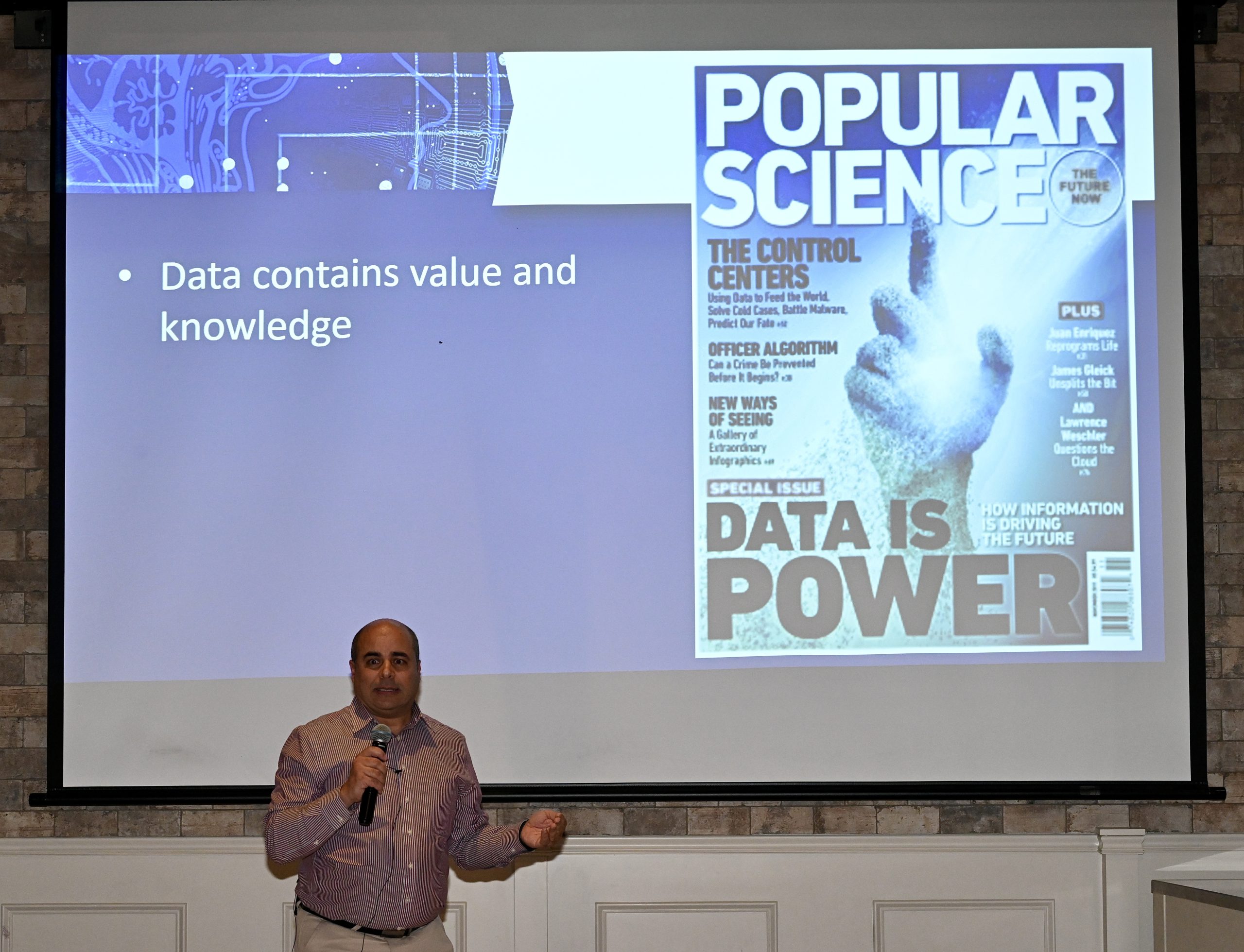
Hourani speaking on how valuable AI is based on its knowledge. 
Defining the definition of AI. 
Speaking about how important AI is to advancing research. 
Explaining how AI helps with prediction and classification.
One of his central points was the massive growth of data in modern society, enabling AI to analyze it. Hourani said we are in the era of data explosion, citing the volume of social media posts, online searches, and online purchases that take place every day.
“Everything is stored somewhere. The question is: why do they record this data? Because there is value in this data, but the data alone is useless unless we extract the hidden insights from it,” he said. “This is where AI comes in to help us find those insights and extract knowledge from large amounts of information.”
Hourani explained that artificial intelligence enables computers to analyze information in ways the human mind cannot, given the sheer scale of modern datasets, describing AI as a tool that helps computers learn from data through structured processes.
“AI, in a simple way, is how to teach the computer to think,” he said. “By writing algorithms, we’re telling the computer how to interact with the data, how to analyze it, and how to extract useful knowledge from it. As humans, we cannot review millions of records at once, but AI can process this data quickly and help researchers find patterns, make predictions, and classify information.”
He said this allows researchers to move beyond basic analysis and begin predicting outcomes, classifying information, and discovering patterns, and that AI has been implemented across a wide range of research areas, including healthcare and agriculture.
“We feed the model with data, such as medical images, and the model can predict whether the patient is normal or has a disease,” Hourani said. “For example, it can analyze brain images or medical scans and help researchers detect conditions like cognitive impairment or other diseases.”
Hourani also said that in agriculture, AI can predict a crop’s health by identifying its type, determining whether it’s healthy, and even predicting which disease it may have.
“This helps researchers, scientists and professionals make better decisions based on the data,” he said.
Hourani also noted that AI systems can achieve high accuracy when trained with sufficient data.
“The performance depends on the data and how much data you have,” he said. “The more data you have, the cleaner and more structured the data is, the better performance you will get. With enough high-quality data, AI models can achieve very high accuracy. In some projects, especially with image data, we can reach accuracy levels as high as 99 percent, which makes AI a very powerful tool for research and analysis.”
As AI evolves, Hourani emphasized that it is fundamentally changing how researchers approach questions and analyze information.
“Now, when we work with data, we can ask new types of questions,” he said. “We can ask if there is something we want to predict or classify in our data. We can ask if we need to group data into clusters, detect abnormal behavior, or generate rules to understand patterns. AI allows researchers to answer these questions and extract knowledge in ways that were not possible before. This is why AI has become such an important tool across many research disciplines.”
More information about the upcoming Science Cafes can be found at https://www.fhsu.edu/smei/science-cafe/ and the FHSU Science Cafe Facebook page.