
By RYLEE BURD Photos by DYLAN LU
Tiger Media Network
Students, faculty, and staff at Fort Hays State University may have noticed increased construction activity around campus this semester. According to FHSU Director of Facilities Planning Dana Cunningham, several key projects are part of a broader plan to modernize the campus and support the university’s long-term growth.
Among the most visible projects are the Tebo (formerly Forsyth) Library renovation, the Bickle-Schmidt Athletic Complex at Lewis Field, a major addition to Stroup Hall, and infrastructure improvements in Tomanek Hall.

The library. Workers are preparing to carry out the roof upgrade. 
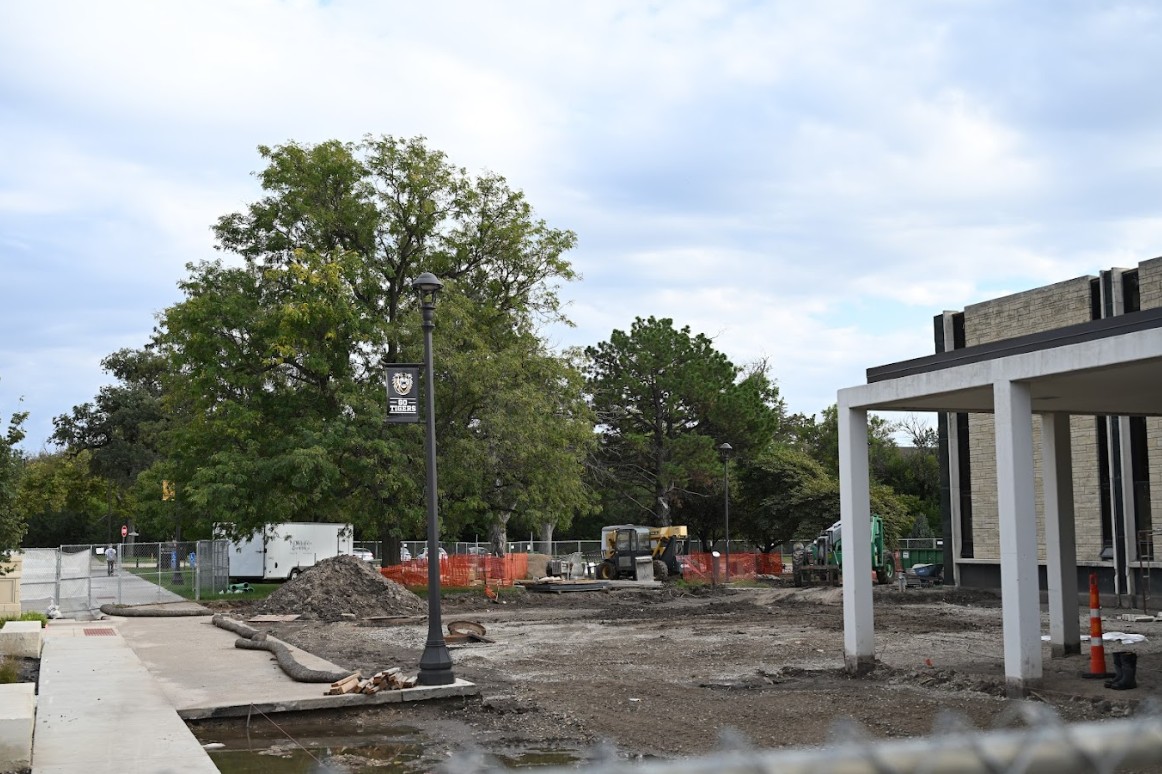
In front of the library, all the floors have been renovated, and some construction machinery was present. 
The west side of Tebo Library 
In front of the entrance of Stroup Hall, the construction site is being carried out by Wiens Company. 
The workers are using laser measuring instruments to make measurements. 
More scenes within the construction site can be seen here in front of the President’s Residence in the background. 
Three differently colored flags represent different utilities, helping the construction team better distinguish different areas. 
The excavator and the excavated ground were surrounded by cones to ensure that no one would accidentally enter this area. 
The various construction machinery used by the construction team 
The workers’ vehicles assist in transporting various tools. 
Two workers are inspecting the east wall of McCartney Hall. 
The construction site in front of the parking lot on the west side of Stroup Hall
The work in Tomanek Hall centers around replacing a nearly 30-year-old air conditioning system that has caused annual summer outages and discomfort. Kristin Wolf, fiscal and operations manager for the building, said the update is long overdue.
“We’re really excited about the AC updates in Tomanek Hall,” Wolf said. “Having a more reliable system that’s easier to service will make a big difference in keeping the building comfortable year-round and creating a better environment for working and learning.”
Across campus, the Tebo Library renovation is transforming the space into a more modern, student-focused facility. While the building is closed, most services have relocated to Custer Hall, and students can still access core resources.
Instruction and Outreach Librarian Cyndi Landis said the Welcome Desk now operates from Custer Hall Room 304, where students, faculty, and staff can check out books, borrow technology, and retrieve interlibrary loan materials. The Media Lab is open by appointment in Custer Hall Room 310.
“Fewer students visit the Welcome Desk in Custer Hall than when we’re all in the same building,” Landis said. “But students have been patient and understanding as we’ve navigated the transitions.”
Landis said one of the biggest losses this semester is the sense of the library as a centralized academic and social space.
“When I ask students where they’ve been studying, a lot of them just say their dorm room,” she said. “They really miss that shared space for academic, social, and intellectual connection.”
To support students during the renovation, alternative study areas across campus—including Rarick Hall, Memorial Union, and the Fischli-Wills Center—have extended hours, and residence halls have encouraged use of study rooms.
Meanwhile, Information Literacy Librarian and Associate Professor Robyn Hartman said the transition has not significantly interrupted her work with students and faculty.
“The renovation hasn’t impacted my work very much—other than being in a different building,” she said. “I’m still working with students and faculty in classrooms across campus, and our online services are as strong as ever.”
Hartman noted that Tebo Library’s digital infrastructure and online resources have made it easier to continue serving the FHSU community—whether during a renovation or across distance learning environments.
Looking ahead, both librarians shared excitement for the new space, designed with student input in mind. The renovated library will feature group and individual study rooms, semi-private study nooks, and an event space that can accommodate more than 100 people. One of the most noticeable changes is the increased natural light, which transforms the atmosphere of the space.
“I’m really looking forward to being settled in my new office,” Hartman said. “I’ll be able to see people coming into the library and help them at their point of need. I’m ready for the library to feel like the heart of campus again.”
In October, the library was officially renamed the Tebo Library, following a major seven-figure gift from FHSU alumnus Stephen Tebo and his family. The donation, announced by the FHSU Foundation, supports the renovation and honors Tebo’s long-standing connection to the university.
Landis said the renaming represents a new chapter.
“This renovation wouldn’t have been possible without the support of the Tebo family and other donors,” she said. “It’s also been inspiring to hear alumni share their memories of the library. Those memories helped drive the project forward for today’s students.”
Hartman emphasized how impactful the gift will be.
“A library may not be the flashiest place to donate to, but the Tebo family’s support directly impacts students’ academic success and helps shape lifelong learners,” she said. “Their gift enables us to offer programs, tools, and resources that empower both students and the wider community.”
Elsewhere on campus, the Bickle-Schmidt Athletic Complex is replacing aging athletic training facilities, while Stroup Hall is expanding to support the rapidly growing nursing and allied health programs.
Chair of the Department of Nursing Dr. Jenny Manry said the expansion reflects the rising demand in the healthcare field and the impressive growth of FHSU’s programs.
“Both of our programs are growing. In the last two years, nursing has gone from admitting 60 students a year to 90—that’s one-third more students,” Manry said. “The additional space will allow us to serve more students while continuing to support excellent student outcomes. In fact, our 2024 NCLEX pass rate and our 2024 DNP National Certification pass rate were both 100%.”
Manry noted that construction has not significantly impacted teaching this semester.
“We’ve been so lucky. Other than a bit of extra noise and some changes with parking, our classes haven’t been affected at all,” she said.
The new facilities will bring Nursing and Allied Health under one roof for the first time, opening doors for interdisciplinary collaboration.
“It’s an exciting opportunity for students to participate in interprofessional healthcare simulations together and for faculty to collaborate on joint projects,” she said.
Looking ahead, Manry is particularly enthusiastic about integrating new technology and simulation tools into the curriculum, and said the new space will benefit future students and faculty alike.
“I’m most excited about the opportunity to have additional space, which will let us utilize new technologies,” she said. “It’s about maintaining quality while we grow. The extra space will allow us to continue offering hands-on experiences and strong faculty support even as we expand.”
Funding for these projects comes from a combination of federal and state appropriations, rehabilitation and repair funds, and private gifts. Cunningham noted that the university carefully coordinates construction schedules to avoid disrupting academic life and prioritizes major work during summer months.
Looking forward, FHSU will follow a 10-year campus master plan approved by the Kansas Board of Regents in late 2024. The emphasis will be on rehabilitation and modernization rather than new construction.
As renovation continues, students and staff remain optimistic about what lies ahead.
“We’ve built on the past,” Hartman said, “to provide new opportunities for the current and future generations of Tigers.”