
By RYAN SCHUCKMAN
Tiger Media Network
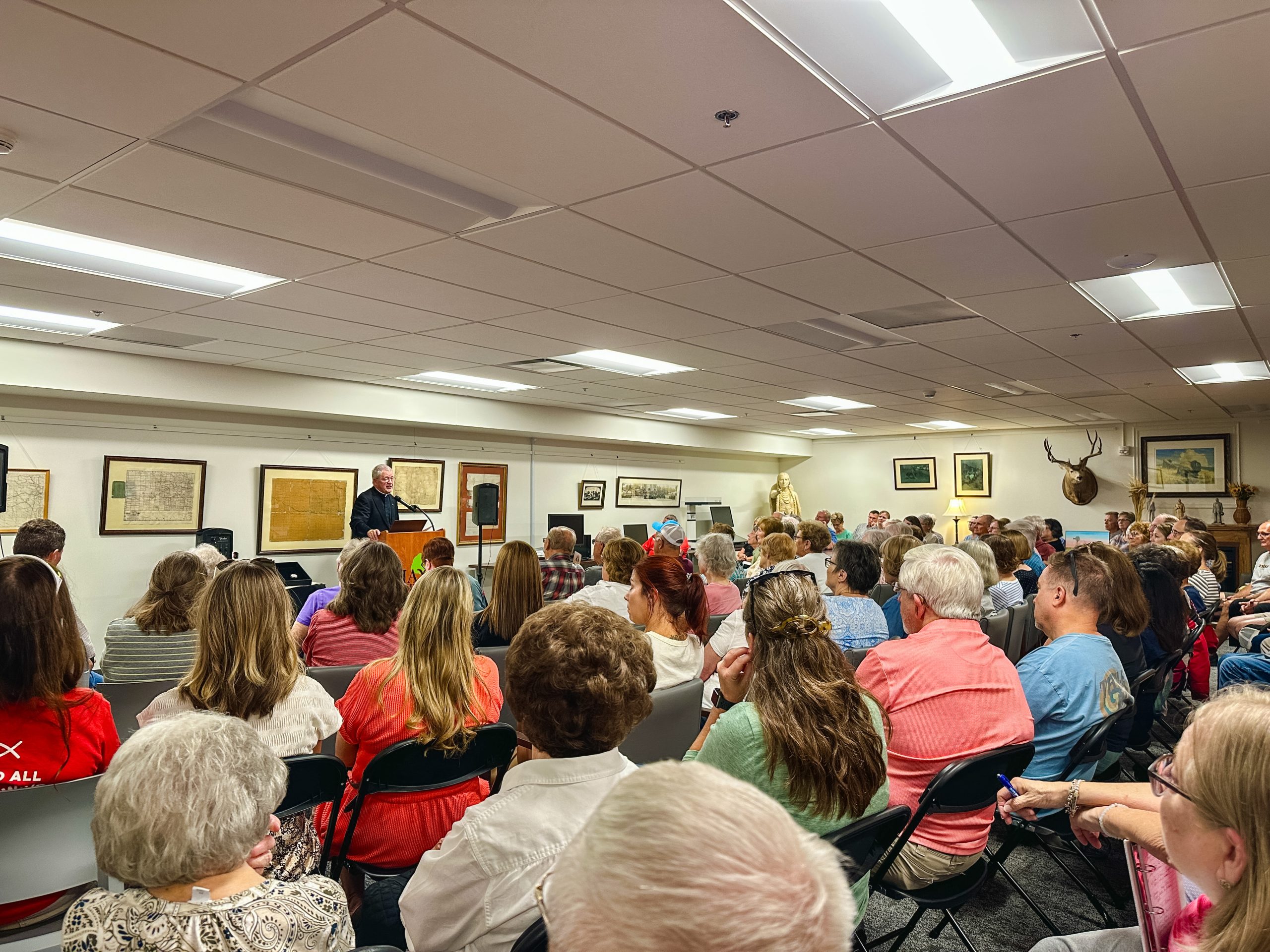
On Thursday, the Hays Public Library hosted a presentation discussing the life and legacy of Fr. Valentine Sommereisen – the Catholic priest who founded eight churches in the Ellis and Rush county areas during the 1870s.
“He could easily be considered a modern-day St. Paul”, said Fr. Reggie Urban, the speaker during the presentation. “Fr. Valentine was a driven Christian missionary, a founding pastor of many parishes and the object of many hardships and rejections.”


Between 1876 and 1878, Sommereisen served a 160-mile area stretching from Russell to Wallace, helping to establish churches in Hays, Catherine, Victoria (Herzog), Pfeifer, Schoenchen, Rush Center and Munjor. Despite serving in the area for only 19 months, he performed 119 baptisms, 19 weddings and 313 funerals.
“Fr. Valentine was quite the independent, driven, charismatic Catholic priest – a pivotal player in the history of Rush and Ellis County in the 1870s, 80s, and 90s,” Urban said.
Born in 1829 in the Alsace-Lorraine region of France, Sommereisen was ordained a priest in Minnesota in 1856. His early ministry included serving dozens of mission stations in Minnesota and acting as chaplain for General George Custer’s troops. In 1876, Sommereisen arrived at Fort Hays just as Volga German immigrants began entering the area.
“I haven’t come across the real reason why he came to Hays,” Urban said. “There is some speculation that because he understood Sioux fluently, he was guessing that there would soon be a major battle between Custer and the Indians – and there was. But perhaps the main reason was because of the growing number of Volga German immigrants since he spoke German fluently.”
Artifacts tied to Sommereisen, including a pocket watch and a cane-gun, were showcased during the presentation courtesy of the Ellis County Historical Society.
Urban also shared plans to erect a plaque at the intersection of Commerce Parkway and Vineyard Road to memorialize Sommereisen. His personal home and vineyard – the namesake for Vineyard Road – were located near the proposed location for the plaque.
“Fr. Valentine and all our ancestors are just great models of perseverance,” Urban said.