
Story and Photos by ABIGAIL SHEARER
Tiger Media Network
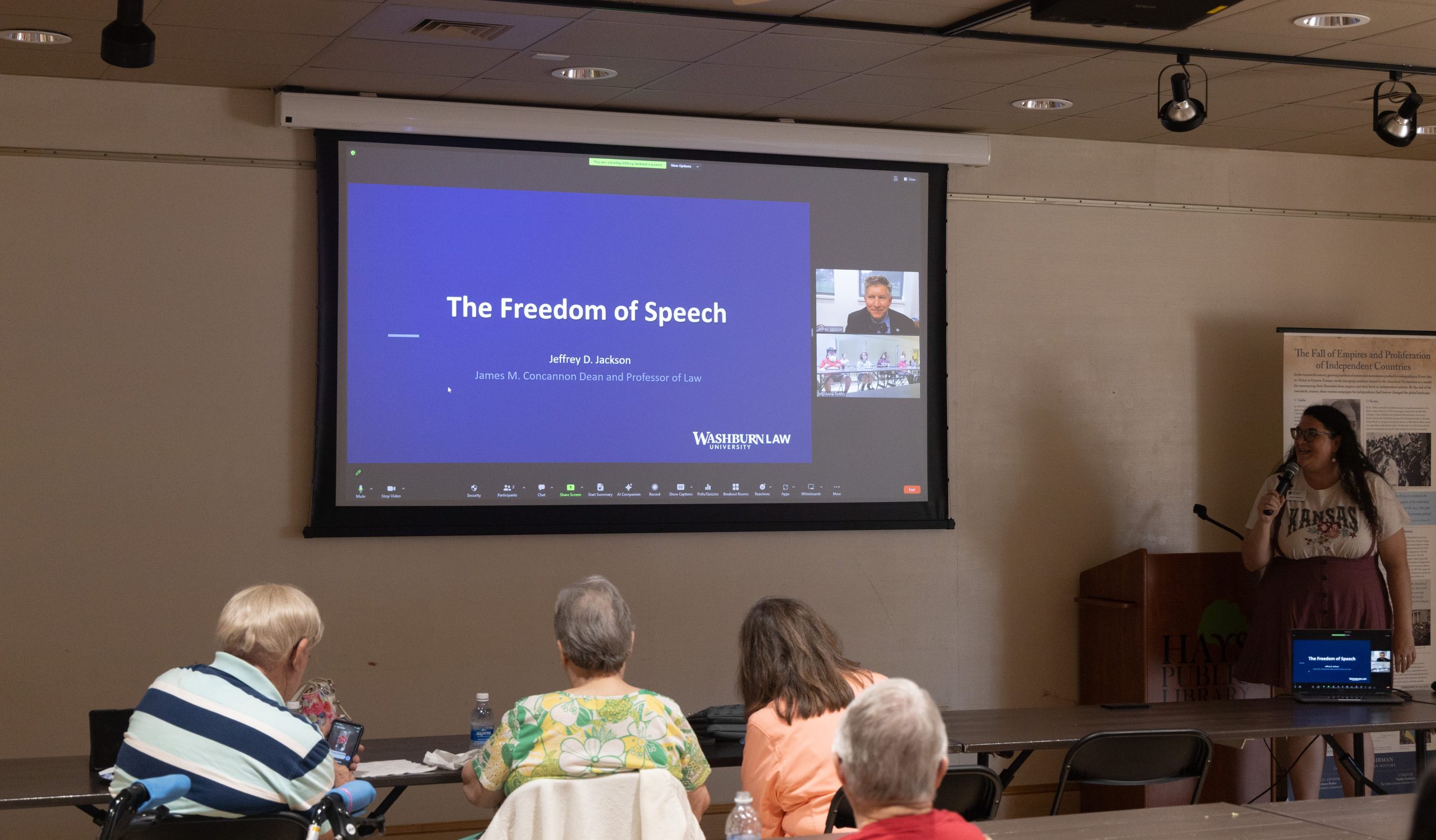
On Tuesday, Tebo Library and Hays Public Library collaborated to host Jeffrey Jackson, a professor of law at Washburn University School of Law, for a discussion of freedom of speech under the First Amendment.
“Congress shall make no law…abridging the freedom of speech, or of the press; or the right of the people peaceably to assemble, and to petition the Government for a redress of grievances. and what it legally protects.”


Jackson explained the two theories of freedom of speech.
“The first one is, this idea that it allows the criticism of the government, that it protects political speech… then there’s a secondary idea that it allows free access to what we call the marketplace of ideas,” Jackson said. “And under that kind of theory, the freedom of speech encompasses pretty much everything having to do with speech.”
The law tends to follow the speech-at-large theory, with the understanding that political speech falls under that umbrella.
Jackson then talked about what “Shall make no law” meant, saying the verbiage is misleading. Congress and the states can enact laws governing speech; however, they cannot abridge it.
Your freedom of speech depends on three things: how you speak, where you speak, and what the government seeks to prevent.
There are three kinds of forums: traditional public forums, such as public property; limited public forums, such as city council meetings; and nonpublic forums, such as government offices.
“They cannot restrict your viewpoint. So whether you speak in favor of it, or whether you speak against it,” Jackson said.
Jackson explained the difference between pure speech and expressive conduct.
“No matter what you’re speaking, you’re communicating a message; but other modes of communication also are pure speech,” he said.
Pure speech encompasses speaking, writing, publishing, painting, music, tattoos, photography, and movies, while expressive conduct is an act that conveys a message.
Jackson said the government can regulate free speech by regulating around the edges, like time, place, and manner.
“So long as that area is a place where your message can get out to the people who are supposed to hear,” Jackson said when talking about protest areas.
There are also “lesser protected” forms of speech, but Jackson emphasized that hate speech is not a protected form of free speech.
“There is no category that is ‘Hate Speech,’ ” Jackson said.
However, incitement to crime is one of the lesser-protected categories, although its definition has shifted over the years.
Jackson referenced the new standard for determining incitement to crime: Brandenburg v. Ohio. The case states that the Advocacy must be directed to inciting or producing imminent lawless action, and the advocacy must be likely to incite or produce the action.
The government can regulate commercial speech to prevent misleading statements or fraud.
While freedom of speech applies to everyone, it is especially true for government employees.
“[If] the government wants to punish you for speaking, we use this thing called a Pickering balance test… we look at the government’s interest in you not speaking against your right to speak as a citizen on a matter of public concern,” Jackson said when discussing government employees’ rights with freedom of speech.
Jackson explained that there are often many questions about freedom of speech on social media or in the workplace.
“Freedom of speech is freedom of speech, free from government intervention. Not free from your employer’s intervention,” he said. “That’s going to be a matter of contract between you and the employer.”
Regarding social media, he said private entities, such as Facebook, can adjust how they monitor posts and content in accordance to changes to their terms and conditions.
“Facebook is not the government, and so Facebook does have the ability to change things in accordance with their terms and service,” he said.
Lunch and Learn is a collaborative project between Tebo Library and the Hays Public Library. The community has lunch together and learns a skill or concept from an expert in that field.