
By RORY MOORE
Tiger Media Network
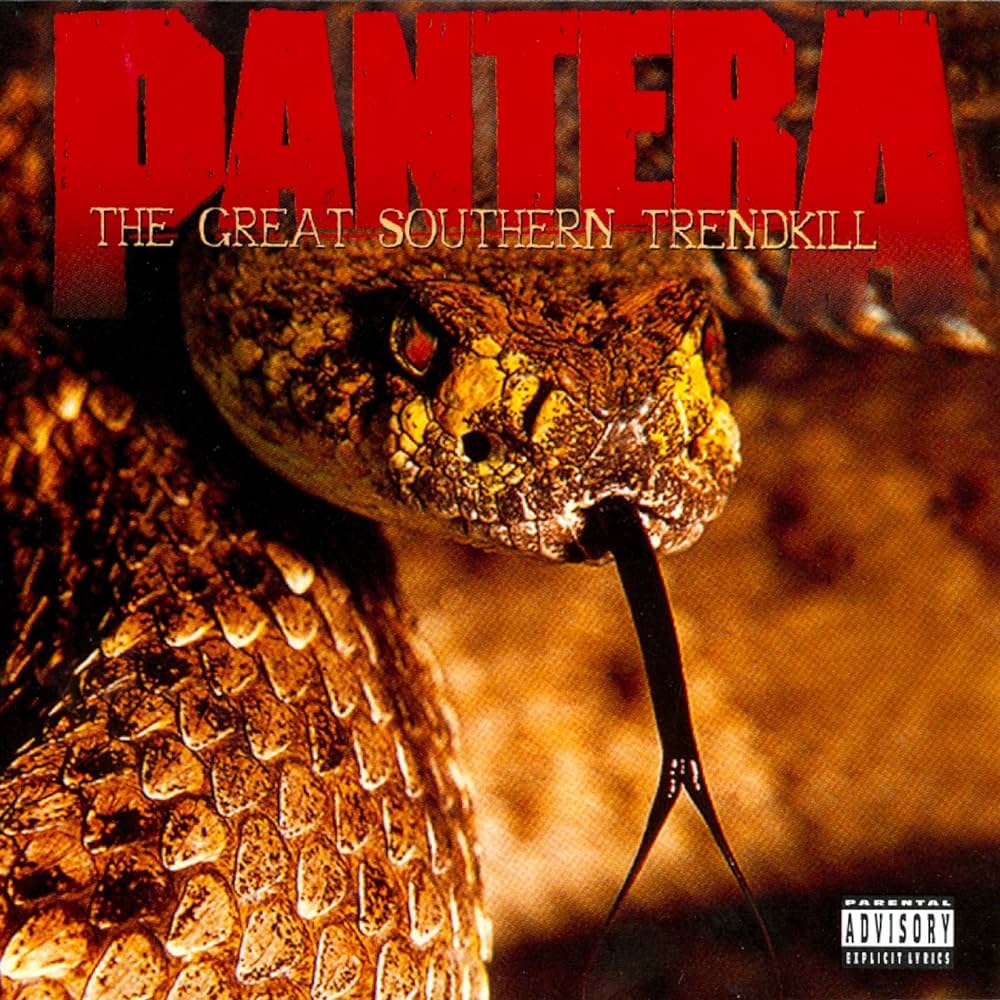
Thirty years ago, on May 7, 1996, Pantera unleashed fury on the heavy-metal scene with their eighth studio album, “The Great Southern Trendkill.” The classic lineup — comprised of Phil Anselmo on lead vocals, the late Abbott Brothers Dimebag Darrell and Vinnie Paul on guitar and drums, and Rex Brown on bass — experimented with their distinctive groove-metal sound by making it as vicious as the demonic-looking Western Diamondback on the front cover.
At a time when metal bands were chasing the success of alternative rock in the ‘90s, the Texas group became disillusioned with the trend of their peers abandoning a heavier sound to appeal to a mainstream audience by being radio-friendly, feeling metal was becoming too “soft and compromised.”
Their response was to defiantly make the most hardcore, aggressive and radio-unfriendly record possible.
“ ‘The Great Southern Trendkill’ means we’re from the South, and we’re killing these trends,” Anselmo said then. “A lot of people miss the heavier edge to stuff that is so watered down today. (It)makes me sick, honestly, and we got thousands of people to prove it every night.”
The recording process was marked by significant turmoil, which also contributed to the album’s extreme tone. Anselmo’s struggles with abusing painkillers and heroin led him to record his vocals separately at the Trent Reznor-owned Nothing Studios in New Orleans, creating challenges for the rest of the band as they worked without him at Darrell’s Chasin’ Jason Studio in Dalworthington Gardens, Texas, with the help of late metal icon Seth Putnam, who provided additional vocals.
The result was 11 songs of unfiltered, head-thrashing, chaotic rampaging of pure nastiness.
The Great Southern Trendkill
The title track begins the album with a sudden blast of Anselmo’s blood-curdling scream, Dime’s explosive distortion, Brown’s bass and Vinnie’s rapid percussion — conveying a level of heaviness that surpasses the band’s previous album, “Far Beyond Driven,” when fans thought they couldn’t get any heavier.
Anselmo growls his lyrics to reflect their discouragement with trends and losing oneself to fame.
“It’s wearing on my mind; I’m speaking all my doubts aloud. You rob a dead man’s grave, then flaunt it like you did create.”
He wastes no time criticizing the fake personas encouraged by trend-setting and contemporary publications.
“F*** your magazine, and f*** the long-dead plastic scene. Buy it at a store, from MTV to on the floor. You look just like a star; it’s proof you don’t know who you are. It’s bulls**t time again. Politically relieved; your product sold and was well received. The right words spoken gold. If I was God, you’d sell your soul to the great Southern trendkill!”
The song closes out with a slower, smoother rhythm with Anselmo’s suave declaration, “Let’s play this one Southern-style!” Dime fills the remainder of the track with a Texas rock-inspired charm that reflects their native roots, coupled with a solo he plays with an attitude defined by sliding and scratching.
War Nerve
After the titular song fades out, the second track expands on the anti-trend theme with rugged, outlaw-influenced riffs that shift its pace to keep the listener on edge, pulling attention to the theme of reducing complex lives to simplistic judgments.
“Truly f**k the world for all its worth, every inch of Planet Earth. F**k myself, don’t leave me out, but don’t get involved, don’t corner me. Meet the lies and see what you are!”
Anselmo, who faced extensive scrutiny for his public struggles and relationship with his bandmates, proceeds to call the media out for judging “what I am in one paragraph,” while metaphorically telling them to take a hike.
“All the money in the f**ckin’ world couldn’t buy me a second of trust or one ounce of faith in anything you’re about! Nothing is worth the sleep that I’ve lost. Apologies unacceptable now; a blistered revenge awaits in me!”
Through the chorus, Anselmo encourages the listener to break free of the judgments and fakeness with the warning, “It’s forcing you down, and it’s grinding against you. Let the war nerve break!”
Drag the Waters
Dime starts the track with a mean riff that reeks of outlaw vibes, accompanied by his brother’s steady-but-blistering pace and a cowbell. Anselmo tackles corruption, nepotism and warped ways people perceive reality and themselves.
“A smack on the wrist is the word from the mouth of the outsider, lawyer, police. A small price to pay for the dope and the guns and the rape, it should all be OK. Your father is rich, he’s a judge, he’s the man, he’s the god who got your sentence reduced, but in the back of his mind, he well knows what he’d find if he looked a little deeper in you!”
While the song’s lyrics are cleaner than its counterparts, it holds no bars in deconstructing the world’s injustices, along with the greed and temptation in people, as it packs a punch.
“Sweet is the slice and the lips, you’re gonna have that woman; she is your favorite lay. Promised you (swore) that no one had been there, and she was gonna keep it that way. Let it move in, you got thin and got high, and your money went, and so did your friends. But she’s by your side, and her smile cannot hide the premonition of a beckoning hand, the end!”
Dime rips some groovy solos that encapsulate the track’s tough attitude, and plays his guitar as if it were responding to Anselmo’s blunt statements of people’s wrongdoings and facing their consequences to “drag the waters some more, like never before!”
10’s
“Trendkill” takes a darker, somber tone with its fourth track, defined by moody, bluesy riffs that create an introspective feel amid the album’s chaos. Anselmo shares a personal viewpoint, unlike the previous three songs, contextualizing his drug dependency and misery by bellowing out his lyrics.
“My skin is cold, transfusion with somebody, morose and old, drop into fruitless dying. It was tempting and bared; the wh*ring angel rising. Now burning prayers, my silent time of losing.”
He cries out in fear of death from his addictions and pain.
“Long for the blur, we cannot dry much longer, cement to dirt, disgusted with my cheapness.”
Dime rips an emotional solo that elevates the track from a feeling of despair to one of determination to defeat personal demons, conveyed by Anselmo’s swear that his foes “can’t destroy my body, colliding slow, like life itself.”
13 Steps to Nowhere
After a slow burn, the album returns to its aggression, with Pantera’s signature sound harkening back to the days of “Cowboys from Hell” and “Vulgar Display of Power,” but with an angrier twist.
“Your windows boarded up, your private lives exposed, the talk shows it up, lab rats diseased for show. We’re doomed to use the slang: ‘outbreak of drug roulette.’ A church burned to the ground, not even noticed yet.”
Anselmo paints the world with a bleak outlook drawn by manipulation, hate and sensationalized suffering.
“The backlash dislocates, untimely reign of death. The wolf poked with the stick, awaits with cancerous breath. Outsiders still suppose there’s holy streets to roam. The truth should not surprise; your homes were built on lies!”
He yells his lyrics with a strained anticipation of society’s demise, establishing an apocalyptic theme that Dime furthers with his doomful riffs. At the same time, Vinnie creates a frantic atmosphere through his machine-gun double bass. Thematically, the track ends nowhere, as the band closes it out with the chorus, “Thirteen, thirteen, thirteen, thirteen, thirteen, thirteen steps!”
Suicide Note Pt. 1
An industrialized transition into the two-part track leads to a stark contrast of relative calm, but with heavy emotional weight. The transition is broken by a Southern-style acoustic riff from Dime that echoes the melancholy of “Cemetery Gates,” albeit with a lower tune. Anselmo’s lyrics tell a narrative of a damaged individual’s thoughts before death.
“Cheap cocaine, dry inhale, the pills that kill and take the pain away. Diet of life, shelter without, the face that cannot see inside yours and mine.”
Anselmo offers a sympathetic reflection of his pain through the pre-chorus, detailing, “When I’m hiding, when I need it, it helps me breathe. For our handle on this life, I don’t believe this time.”
This is followed by the second verse, which conveys the loss of hope and the will to live.
“Forever fooling, free and using. Sliding down the slide that breaks a will. Mother’s angel, getting smarter, how smart are you to regress unfulfilled?”
As a troubled soul, Anselmo injects his place as a troubled soul through the song’s repeated chorus that asks the listener, “Would you look at me now? Can you tell I’m a man? With the scars on my wrists to prove I’ll try again, try to die again.”
Despite the sad theme, the album offers a break from the fray with a somber, quiet piece that offers light at the end of the tunnel, accompanied by a subtle keyboard. The listener has a brief breather as the song ends softly, only to be violently shoved back into the metal mayhem.
Suicide Note Pt. 2
“Out of my mind, gun up to the mouth. No pretension, execution. Live and learn, rape and turn. Fret not family, nor pre-judged army. This is for me, and me only; cowards only try it!”
The track’s second part bursts into the album’s marquee-fast, loud tempo, dialed up to a nine. Being the polar opposite of part one, the band reaches their heaviest, hard-thrashing sound that makes their groove-defined tune flirt with Death Metal, comprised of a head-on percussion attack from Vinnie, while Dime makes his guitar scream for its life with a bone-chilling shriek amplified by a DigiTech Whammy effects pedal that complements Anselmo’s relentless screaming.
The lyrics make a vivid description of hopelessness and pain as Anselmo comes off as at his wits’ end and deranged at once, warning that it’s not worth the time to try to “replenish a rotting life.”
He begs the question of why one would help anyone who “doesn’t want it, doesn’t need it when a mind’s made up to go ahead and die.” Anselmo urges the listener, “Don’t try to do like me,” warning that suicide is “livid and it’s lies, and makes graves descending down,” as the track closes with a death march towards the end.
Living Through Me (Hell’s Wrath)
Another fast-paced tune, the trendkilling transitions into an unrelenting fury that tackles addiction and toxic relationships.
“I cannot take the take, your condition was nod awake. A selfish crier, boldface liar, robbing all of what you could take in. Sh*t decisions, no provisions, filling veins with juice of chaos.”
Anselmo explores the troubles that addiction brings, diving into it turns one into a selfish, self-loathing liar, mirroring his struggles as a former addict. He demands the listener to “drop the needle and stop what you’re changing into” after seeing it all in hell’s wrath. The raw energy comes to a grinding halt after the blunt message, “Now you’re living through me!”
Floods
The album’s most popular track, Pantera turns things down a notch with a slower, mellower tempo encapsulated by a haunting acoustic riff from Dime. At the same time, Anselmo tells the narrative of humanity’s end like a grizzled soul.
“A dead issue, don’t wrestle with it, deaf ears are sleeping. A guilty bliss, so inviting, nailed to the cross!”
The seven-minute epic draws parallels to the Biblical flood from the Book of Genesis, which God punishes mankind with for its atrocities and horrors committed, prompting the narrator to call for a catastrophic cleansing of the cold-hearted world.
“Then throughout the day, mankind played with grenades,” Anselmo exclaims. “And at night, they might bait the pentagram, extinguishing the sun. Wash away man, take him with the flood!”
The song then shapeshifts through numerous phases and tempos, including a solo that is regarded as the best of Dime’s career and captures the theme of longing for redemption, before he ends it with a lullaby-like outro heightened by rainfall and thunder.
The Underground in America
The album ends where it began, calling out the trends and those selling out for a cleaner sound while pretending they’re part of America’s underground culture.
“Put in position to wage teenage mayhem, a common affair for the ones who are juiced. If it is weakness that grants us the power, we thrive on what’s stronger than most of the world!”
Anselmo gives a furious takedown of the scene posers he perceives as embracing whatever seems trendy while putting on a persona.
“Cheap beer, trendy cliques. If it is free from a family that’s seen, you can just keep it. If you must beg, it’s better instead. You must follow the etiquette. You act so real when you are alone, you better not let the mohawked crowd see; give it five years, you’ll retire your piercings!”
He ushers in these scathing critiques of people who hide their true selves while using the underground as a phase, getting his point across by shrieking “fake” between the lyrics that take up the song’s bridge.
The band stops thrashing at what seems like the album’s end, with the addition of industrialized sound effects that tweak in the background as Anselmo yells that the “trend is dead,” only for Dime to start playing the second riff from “Underground.”
(Reprise) Sandblasted Skin
Just as the listener thought the chaos was done, the band picks up where they left off, taking the thrashing further with an all-out assault on the eardrums: frantic percussion that keeps a speedy rhythm as Anselmo growls for the trend to be scraped, ground, peeled, hidden and shelved to be forgotten.
“Waste of time, pantomime, circus doll at the local mall; exterminate! It’s all fake! Sandblast yourself!”
The band crushes the fad with its hardcore jamming, culminating with the song fading out into a minute-long silence before the song fades in full force, but louder, before coming to a crashing conclusion defined by Anselmo’s proclamation: “The trend is over, and gone forever!”