
By RORY MOORE
Tiger Media Network
Fort Hays State University’s Science and Mathematics Education Institute hosted the Fossils, Museums, and 66 Million Years Science Cafe at the Venue on Monday. The event featured Assistant Professor of Geosciences, Curator of Paleontology and Geology Amanda Peng. In her lecture, Peng discussed the influence of landscapes on biodiversity during the Cenozoic era, particularly the Great Plains and Rocky Mountains.

The FHSU Science and Mathematics Education Institute hosts the “Fossils, Museums, and 66 Million Years” Science Cafe inside the Venue. 
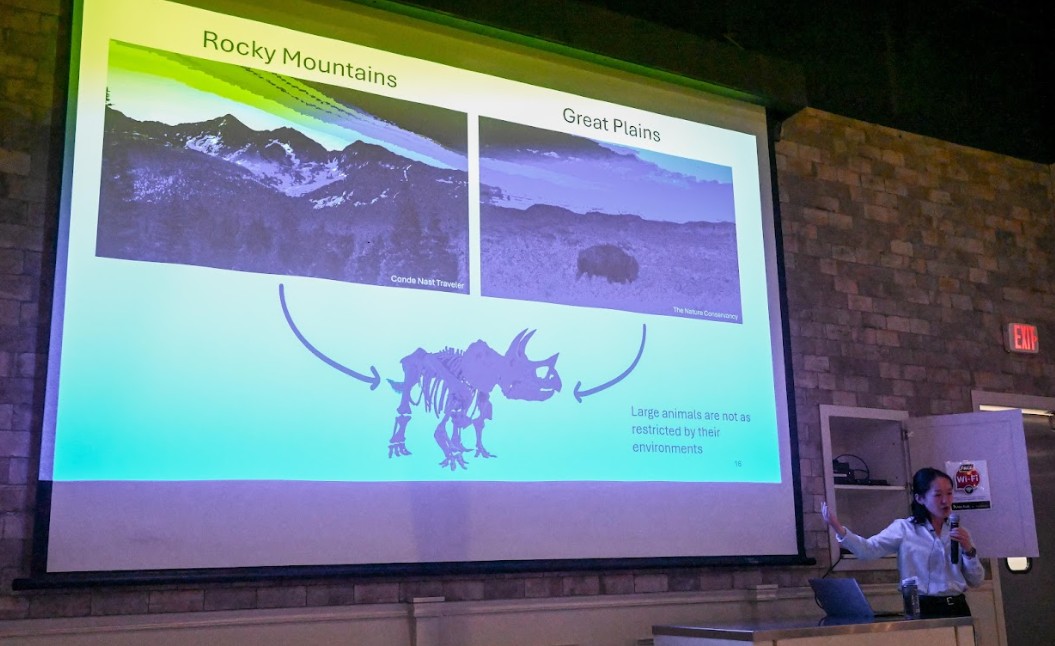
Amanda Peng, Assistant Professor of Geosciences and Geology, educates attendees on the natural and climatic changes of the North America’s landscape and impact on fauna. 
Talking about the movement of the North American Continental Plate. 
Speaking of the environmental influence on animals based on size.
The majority of the lecture focused on how the shifting of the American Continental Plate affected the evolution of biodiversity during the Cenozoic Era after the Dinosaurs went extinct.
“The Rocky Mountains were built beginning around 80 million years ago by tectonic processes,” Peng said. “That mountain building created complex topography compared to the Great Plains. This complex landscape is the result of tectonic activity over many millions of years, and those geologic processes created environments that life then had to adapt to.”
Peng contrasted the rugged, mountainous West with the flatter plains, noting that each landscape produced different ecosystems and animal communities.
“These landscapes are characterized by being very homogeneous with flat topography,” Peng said. “A lot of these areas today are covered in grassland ecosystems – the kinds of landscapes we’re used to seeing here in Kansas. The Rocky Mountains are geologically, ecologically, and biologically different since the animals you’d find in the mountains differ from what you’d find out here on the Plains. This complex topography in the Rocky Mountains is the result of tectonic activity over many millions of years, and those geologic processes created the landscape that life then had to adapt to.”
The animals that Peng primarily focused on when detailing this result were rodents due to their abundance in the landscape and fossil record.
“They’re susceptible to barriers to migration,” she said. “They can’t just traverse mountains or obstacles easily, so they stay put and evolve in place as the landscape changes around them. They respond rapidly to environmental changes, they have short generation times, and they’re incredibly diverse.”
She pointed out that rodents make up nearly half of all mammal species, and that their evolution correlates with landscape change.
“Our teeth have a tight correlation with body size,” Peng said. “Mammals need a certain surface area of teeth to sustain their body mass, so we can estimate body mass just from a single tooth. Each of these little vials in the museum is full of one rodent tooth. Sometimes, it’s a tiny speck, but from that speck, we can estimate the size of the entire animal. We go to museums and very painstakingly measure thousands of these tiny teeth. It’s slow, detailed work, but it gives us an incredible dataset to understand biodiversity through time.”
Using those measurements, Peng compared fossil data from the ‘active region’ in the Rocky Mountains to the ‘passive region’ in the Great Plains.
“Taxonomic diversity is higher in the active region, so there are more species in the Rockies,” she said. “When we look at morphological disparity – how different those species are from each other – it tells a completely different story.”
She showed the audience an unexpected result from this disparity.
“Even though there are fewer species in the Great Plains, they’re actually more morphologically diverse,” Peng said. “Despite being more flat and homogeneous, we’re actually getting more functional diversity in the Plains, which is the opposite of what you might expect. If we only looked at species counts, we would have missed that story entirely. More species don’t automatically mean more biodiversity in the ways that matter. What really matters is what those organisms are doing in their ecosystems. The Great Plains might look simple and flat, but evolution has been anything but simple.”
Peng emphasized that museum collections make this kind of research possible, preserving fossils that allow scientists to study ecosystems millions of years old.
“Museums are key to understanding past, present and future biodiversity,” she said. “None of this work would have been possible without museum collections, and these fossils give us a window into ecosystems that existed millions of years ago and help us understand what’s happening today.”
For more information about the upcoming Science Cafes, visit https://www.fhsu.edu/smei/science-cafe/ or follow the FHSU Science Cafe Facebook page.