
By RORY MOORE
Tiger Media Network
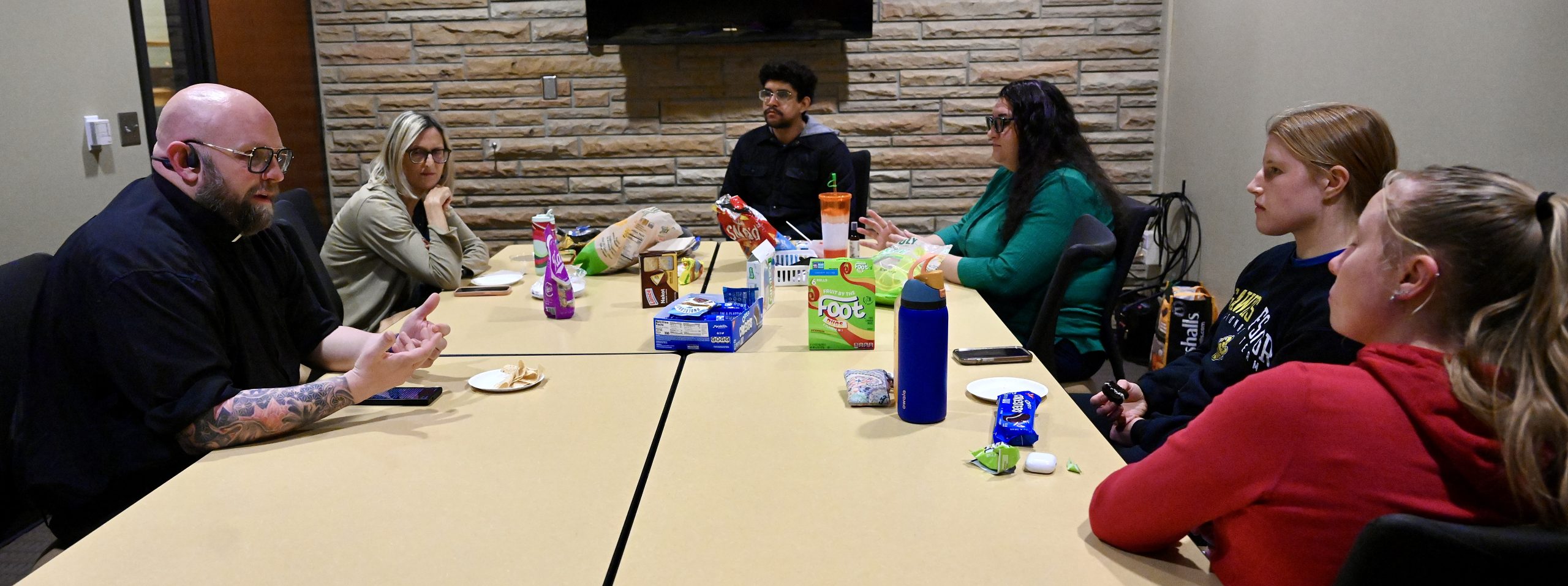
Fort Hays State University’s Us 4 U faith-based student organization hosted its monthly Spiritual Wellness meeting in the Memorial Union Meadowlark Room on Tuesday to discuss spiritual practices for maintaining well-being. The meeting was headlined by Fr. Ben W. Houchen of St. Michael’s and St. Andrews Episcopal Church, alongside Tebo Library Engagement Specialist Anna Towns and English Professor Cheryl Duffy. Us 4 U President Breanna Hemken, members Lexi Burton and Yoandri Dominguez Garcia joined the discussion.
The main topic of the discussion was gratitude for the Thanksgiving holiday.
“We look at gratitude and Thanksgiving like they’re the same thing,” Houchen said. “I don’t think they are. When we talk about Thanksgiving, we’re talking about it like an event, and it’s often tied to a specific narrative. It gets to feel obligatory, like when we sit around the table and everybody has to go around and share something they’re thankful for. That all sounds fine, but it feels very transactional.”
Houchen shared that thankfulness is more than a holiday tradition.
“I’m thankful for my health, family, and job,” he said. “But thankfulness recedes a lot of times. The word in Greek for gratitude is Eucharist, which is the act of our communion we take. So, the idea of the Eucharist is, rather than it being something that we or something we have, I have this thankfulness for this thing. The Eucharist is something that we are and are becoming constantly. It’s not about what we have, but what we are.”
Houchen emphasized that the Eucharist is important because thankfulness is something people do for good things, whereas gratitude is a feeling to live through in the midst of hardship.
“It’s important to remember that around this time of year, because we get into this idea of what we are thankful for,” he said. “When it feels like everything is falling down around us, it can seem cheap to talk about being thankful, but if we can move more towards gratitude rather than just Thanksgiving, it’s a move that is more grounding in the midst of these things that are happening right now.”
He attributed the grounding of gratitude to faith.
“Gratitude is something that is directed at faith,” Houchen said. “It’s directed at God, and whatever concept of God you have, the idea is that it’s directed at the grounding of our faith. Julian of Norwich says the posture of gratitude is that all shall be well, and all manner of things shall be well. So, it’s not thanks for a circumstance, it’s thanks for a thing, and it comes from the fact of our life. That life is within that divine love and grace.”
Houchen shared two practices to maintain spiritual wellness.
“The first one is the examination of consciousness,” he said. “This is an Ignatian prayer practice where, at the end of the day, you take time to ask two questions: What moment today am I most grateful? What moment today am I least grateful? When you ask the first question, you’re looking for a peak moment of connection of peace of joy. When you look for the moment you’re least grateful you ask where God was in that moment. It trains you to look for that hope, seek gratitude, so that you are finding that grounding in the midst of struggle.”
The second practice he shared is the 54321 method.
“The idea is, when you’re feeling anxious and in the midst of ‘I need this thing to get by the next moment,’ you can take a minute and pause to look for grounding,” Houchen said. “You stop, look for five things you can see, four things you can feel, three things you can hear, two things you can smell, and one thing you can taste. You focus on those things, and we’re focusing on them as things provided to us. So, we’re looking at creation, the soundscape of life, and what sustains us.”
Duffy added reflection to this practice through her experience battling breast cancer.
“It’s dealing with what life throws at you,” she said. “It was [about] 10 years ago that I was diagnosed with breast cancer, so I went through surgery and chemo, but I can remember being grateful that I was in a developed country, and not in Afghanistan experiencing breast cancer because what must that be like? After surgery, you don’t realize how much you use those muscles just to push yourself up.”
Another method Houchen shared was the High-Low Buffalo, a method he developed with his family by sharing a positive, negative, and unexpected experience.
“For High Low Buffalo, I’ll ask my kids at the end of the day, ‘High Low Buffalo?’ and they’ll give a high for the day, a low for the day, and a buffalo, which is something that was unexpected or crazy about the day. It started off as a way to engage the kids, but it really has become something that’s gratefulness grounding.”
For more information about Us 4 U, contact Anna Towns at amtowns@fhsu.edu or visit the Us 4 U TigerLink page.