
By RORY MOORE
Tiger Media Network
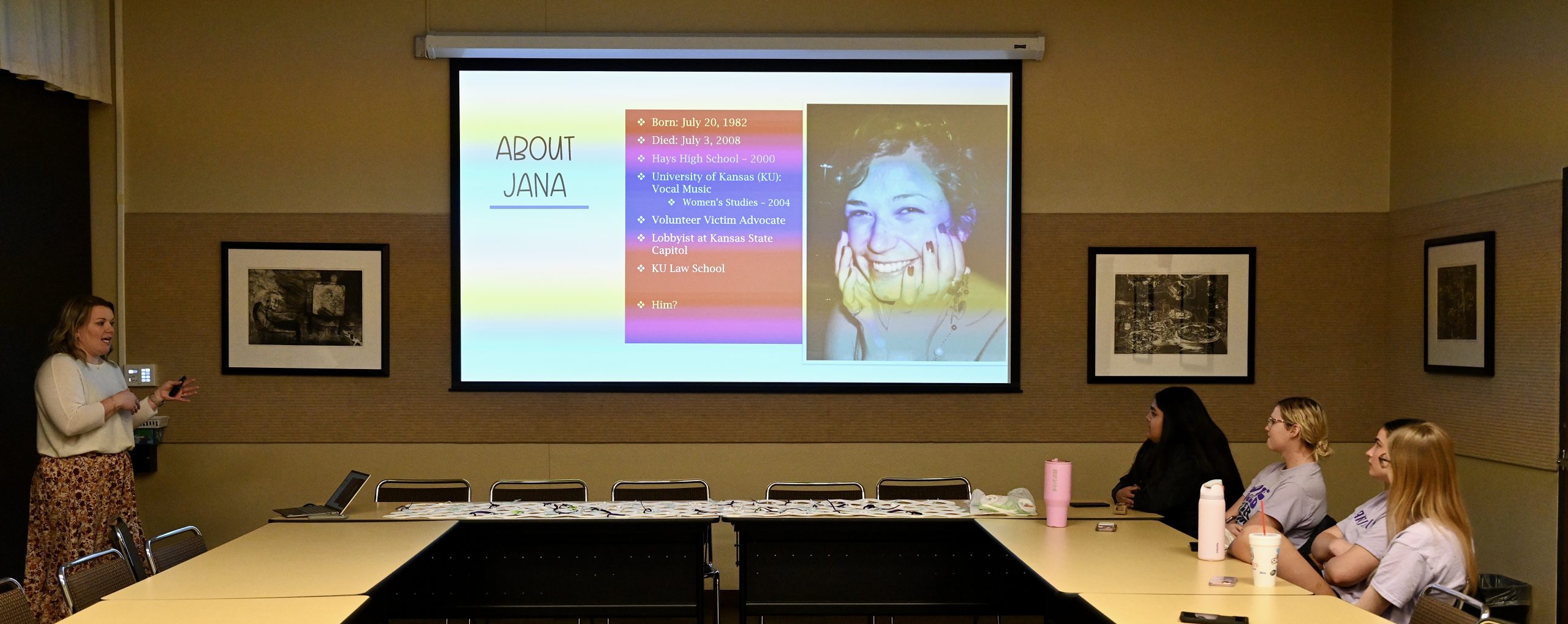
Fort Hays State University’s Social Work Club hosted Jana’s Campaign at an educational workshop to teach how to build healthy relationships and prevent abuse inside Memorial Union on Wednesday. The event featured Jana’s Campaign Executive Director, Katie Blackburn, who gave insight into learning how to set acceptable boundaries, recognize warning signs, and support others.
“We believe violence is a learned behavior and we can unlearn violence,” Blackburn said. “We also believe it’s on a continuum, and that continuum starts in one spot, and as it’s normalized in our society, it escalates to further violence that starts with sexual harassment-type behaviors like inappropriate comments about somebody’s body, cat calls, whistling, inappropriate gestures, and really anything that makes somebody feel uncomfortable.”


One issue Blackburn wanted to tackle through the workshop was the normalization of such behaviors and how they perpetuate abuse.
“When those behaviors are normalized, they can escalate and lead to other behaviors like dating violence and stalking,” she said. “The thing about stalking and sexual violence/harassment is we don’t have to have a partner or ex-partner to experience those things since they can occur outside of a relationship as well. But then domestic violence would be any kind of married couple or long-term partner in an unhealthy or abusive relationship.”
She pointed out that the various terms for these issues, such as relationship violence, dating violence and sexual violence, add complexities to how to address the overall issue.
“At Jana’s Campaign, we use gender relationship violence or relationship-based violence to try and be encompassing of all the different aspects of these issues,” she said. “Over the past decade, we know relationship violence, sexual assault and stalking have become recognized as serious issues that have historically plagued college campuses.”
Relationship-based violence, as Blackburn lectured, is a series of acts or patterns of behavior designed to control a partner, which can result in injury or death.
“It doesn’t have to be physical,” she said. “It can include threats, emotional abuse, insults, isolation from friends or family, name-calling, controlling what somebody eats or how much they eat. Some common red flag behaviors in unhealthy relationships are guilting or gaslighting, which involves making your partner think a situation didn’t happen or their perspective is not what occurred. That also involves belittling, being overly critical, and deflecting responsibility. They don’t take accountability for their own actions, and they blame their partner or others for relationship issues.”
Blackburn singled out how isolating a partner can stem from extreme jealousy, especially if the abuse is against a younger partner.
“Maybe it moves too serious, too fast,” she said. “For young people, that’s actually common, and there’s lots of things that can contribute to that extreme jealousy. Maybe they’re jealous of who their partner is hanging out with, so they start to isolate them and don’t allow them to hang out with those people because they don’t like who they are. [That can be] manipulation, coercion into doing things they typically wouldn’t do.”
Emotional or verbal abuse, like gaslighting or manipulation, is difficult to recognize for people outside of the relationship due to such signs being more subtle, and this escalates the abuse faced by college students.
“Statistics show that 13% of all students experience rape or sexual assault through physical force, violence, or incapacitation, and that’s both graduate and undergraduate students,” she said. “We also know that among graduate and professional students, 9.7% of females and 2.5% of males experience rape or sexual assault. Among undergraduate students, 26.4% of females and 6.8% of males experience rape or sexual assault.”
According to RAINN, 90% of campus sexual assaults are committed by a perpetrator who the survivor knows.
“In our society, we’re typically taught that it’s going to be a stranger,” Blackburn said. “Unfortunately, on college campuses and in general, sexual assaults occur with an acquaintance; it could be somebody you go to class with or live in the same residential hall with, or maybe you party with the same people with them. There is that direct connection at some point.”
Relationship violence has gone beyond physical and verbal abuse, as technology-facilitated abuse is an issue that organizations like Jana’s Campaign are studying.
“We’re seeing it take place at high rates,” Blackburn said. “That can include cyber stalking and harassment, non-consensual sharing of intimate images, uploading those images into AI and asking it to generate a nude image by taking somebody’s face and putting it on a nude body.”
Control and manipulation have also spread into technological circles.
“Things like Life 360, looking at Snap Map, Find My iPhone, abusers often use those apps to pressure their partner into their locations and constantly checking up on that,” she said. “Because of the way technology crept into this type of world, there’s an aspect of financial abuse, too, like threatening to post a picture if someone doesn’t give them money or sexual favors.”
Blackburn emphasized that the best way to combat these forms of abuse is through healthy behaviors.
“These are the things we should be striving for in our relationships,” she said. “[One of those is] good communication. We can openly discuss our issues and be respectful with that; we respect one another’s beliefs, interests, and values, even if they differ from ours. We’re trusting and honest in an equal or balanced relationship.”
Devoting one’s time to responsibilities and personal confidants is another way to establish healthy boundaries.
“Each of you has time to spend away from other people, so you have independence,” Blackburn said. “Take care of your own responsibilities as well as just spend time with our friends outside of our dating partners.”
The key method to maintaining a healthy relationship is respecting one another and gaining consent for all activities, not just sexual.
“We make mutual choices,” she said. “It moves at a comfortable pace. We’re supportive of one another, take responsibility for our actions, words, and how they impact our partner. We should enjoy spending time with each other and being out the best in one another. All aspects of life require boundaries, and saying no is a healthy boundary, so is saying you need time to think about it.”
If you or someone you know is in an abusive relationship on campus, consult Title IX Coordinator Laurie Larrick at lelarrick@fhsu.edu or the FHSU University Police at Cuter Hall or 785-625-1011. For confidential contact, consult the Health & Wellness Center at the third floor of the Fischli-Willis Center for Student Success or call 785-628-4401.