
By RORY MOORE
Tiger Media Network
Fort Hays State University’s Science and Mathematics Education Institute hosted the 144th Science Cafe at The Venue inside Thirsty’s on Monday to explore the topic “The Biochemistry behind Lust, Attraction, and Companionship.” Professor of Biochemistry and Molecular Biophysics James Balthazor was the guest speaker and provided a detailed analysis of how brain chemistry influences romantic relationships.
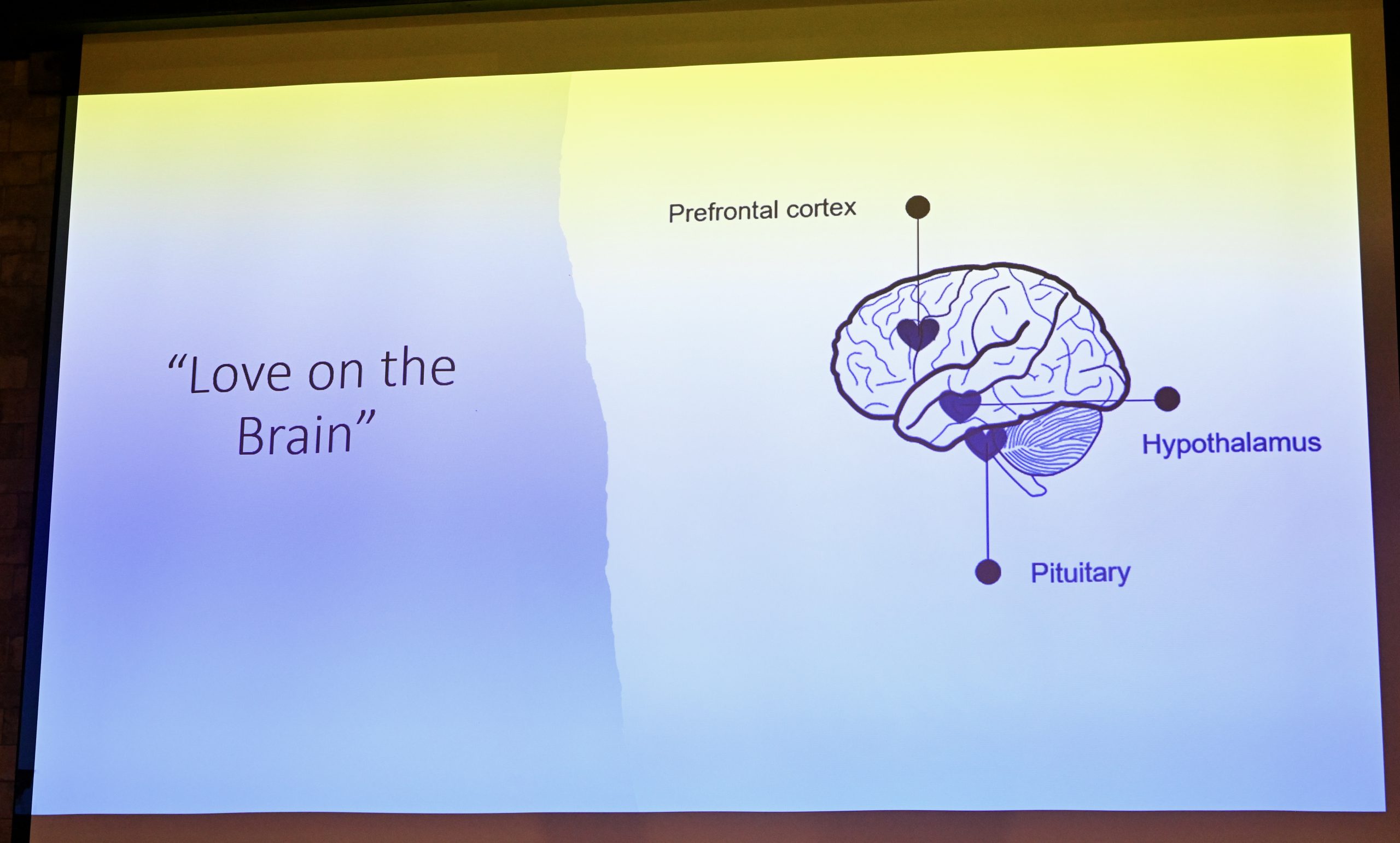
“The science of love is simpler and complex than what we might think,” Balthazor said. “According to a team of scientists at Rutgers, romantic love is broken down into three categories: lust, attraction, and attachment, and each of these stems from the brain.”
Balthazor began with the biochemistry of attraction and how the body responds to the feeling.
“Every time you think love comes from the heat, you’re absolutely wrong,” he said. “It comes from the brain. It may feel like your heart’s beating out of your chest, but that’s norepinephrine, dopamine and testosterone hitting your limbic system. We do have sex hormones that don’t come from the brain; ovaries and testes, which secrete our testosterone and estrogen, and that’s what’s going to drive our sexual desire.”


Balthazor said dopamine, oxytocin and vasopressor, are all made in the hypothalamus, the region of the brain that controls vital functions and emotions. This chemical reaction in the prefrontal cortex leads to a reduction in rational thought when a person falls in love
“So, that’s probably why you get a little bit goofy when you fall in love,” he said.
Balthazor also explained that lust is driven by a desire for sexual attraction and its evolutionary basis stems from humans’ need to reproduce, a need that is shared among all living things.
“Estrogen is the drive for reproduction, and during times of ovulation, those estrogen levels are going to be high,” he said. “If we look at what modulates changes in sex hormones, these are specific receptors that bind. They’re similar, but they bind differently and give different responses.”
This bind is what Balthazor referred to as the induced fit.
“Without this induced fit, we don’t get this ‘let’s get it on’ mentality,” he said. “This is very much a tertiary structure, and proteins that are going to be played into it, which leads to a quaternary interaction. If I were a three-dimensional structure and you’re a three-dimensional structure interacting with each other, we’re having a quaternary interaction. That’s what these hormones are doing.”
Attraction can occur simultaneously with lust, but Balthazor pointed out that it sometimes happens without it.
“Attraction usually involves some brain pathways that control the reward center,” he said. “This is dopamine when you get something that is phenomenal or you love. Maybe it’s chocolate, football, or your spouse. Dopamine is produced in the hypothalamus, and it’s a great player in the reward center. This is released when something feels good to us, no matter what you do. If there’s something you enjoy, like spending time with someone, you’re going to get that dopamine dump.”
Norepinephrine is the chemical that keeps a person grounded or hesitant during attraction.
“It’s that fight or flight response,” Balthazor said. “When you’re running from a bear and you get that big dump of norepinephrine, that says, ‘Hey! We’ve got to get away!’ That’s the same interaction that happens when you fall in love with someone. Your body is saying, ‘I like you, but I should maybe run away.’”
After love and attraction are formed, oxytocin becomes a regulatory hormone in the brain, helping maintain attachment.
“When you fall in love, you usually tend to want to be around that person,” he said. “For that reason, dopamine and oxytocin are the things that are most widely produced in super large quantities when we go through actual biochemical love, and those are the two chemicals that are driving the idea [in a couple] that maybe we’re going to populate eventually.”
He included the negative aspects of this chemical reaction when a partner falls out of love or commits adultery with another partner.
“Those same hormones regulate the flip side of the idea,” he said. “It’s going to be the same chemical pathway but on a different level. The more we upregulate or downregulate something, the more response we get, and maybe a flood of dopamine makes you love someone, but starving from dopamine makes you hate someone. That same hormone is going to make us feel jealous, erratic, and have some crazy behaviors. Ultimately, they’re the same behaviors that lead to abuse of alcohol, eating, and maybe adultery. Those same things make you want to have a positive relationship, but are going to cause you to have a negative relationship as well.”
Balthazor attributes dopamine as responsible for causing toxic relationships as equally as healthy relationships.
“Dopamine is, ‘Yay! We’re in love!’ But it’s still the same molecule that says, ‘We’re not happy,’” he said. “The same regions that light up when we’re feeling attraction are the same regions that light up when we’re having an addiction to drugs. The longer the dopaminergic response, the better the outcome. So, if you’re in love with someone, you’re riding high in the Honeymoon Phase. Some of us [couples] last a little longer than others, but it’s not as strong as it could be, and an act that undergoes withdrawal is no different biochemically than as someone who’s been friend-zoned.”
In the end, Balthazor stated that the stability and length of a romantic relationship depend on the hormones produced in the brain and what that brain chemistry causes to transpire in a person.
“It’s so complicated because we don’t know how much of each hormone is going to be produced,” he said. “As we produce more and more of one hormone, it tends to scale in our favor, but not always. You can still get those same things now; attachment, lust, those are all great things, but they don’t always bode well for monogamy. They tend to drive us to want to keep looking, so we keep chasing that white rabbit’s boat, so to speak. Oxytocin’s also been tagged with us chasing things outside of what we already have. It can be a double-edged sword, so if you’re chasing that dopamine high with your spouse, just know that too much dopamine can cause us to essentially run away from them.”
The next Science Cafe at The Venue will be “Understanding Life Through Genomic Data Mining” at 7 p.m. on Nov. 10.