
By RORY MOORE
Tiger Media Network
The Fort Hays University Farm is giving hands-on experience to students through livestock and agriculture training throughout the semester. Its management and staff provide basics on caring for and treating animals across the 3,825-acre farm while preparing them for their entry into the agriculture workforce.
University Farm manager Mark Weve implements this training by incorporating the practical aspects of farm work.
“We’re a fully functioning farm,” he said. “A lot of these kids come off farms, so they’re familiar with what goes on. Some aren’t, but as they come in, they learn the feeding process we do each morning [things] like taking care of the cattle, sheep and pigs. We’ll put together a plan, whether it’s feeding them hay or grain, so they know how many buckets to give.”

Nate Sterneker and Camden Rietcheck perform morning chores, feeding livestock on the University Farm. 
Pouring grain for cattle. 
Feeding on grain. 
Sterneker throws feed for pigs. 
Eating away at the swine division pen. 
Rietcheck carries hay. 
Eating hay. 
Feeding cattle out on the pasture. 
Sterneker walks through another group of pigs after filling a grain feeder. 
Rietcheck feeds and drives.
Although some students lack experience in farm work, leadership at the University Farm has no challenge in educating them.
“They learn very quickly,” Weve said. “We try to think of what we want to say since safety is a concern. There’s a lot of things that can happen on a farm, which is the one concern with kids that aren’t familiarized with what goes on. With cattle, you have to be aware of where you’re at, like not getting in a pen with something that you’re not familiar with. Even with the sheep and hogs, you need to be aware of your surroundings. So, don’t get in a position where you’re going to get hurt.”
Camden Rietcheck performs routine chores by feeding the facility’s livestock, but has gained some experience from spending his childhood on a farm.
“I grew up showing cattle but we didn’t do production,” he said. “We were around livestock all my life. So, being around the University Farm has given me more of a perspective on the production side versus the showstopper side of things.”

Lauren Mack teaches a class about birthing a calf with a simulation. 
Mack shows how to correct a calf’s arm lock to prevent injury. 
Showing how to apply chains during a calf birth. 
Mack has her students measure their length from the birth process. 
Display the use of strapped equipment. 
Showing how to use a birthing poll.
The new experience he has accumulated helps maintain his confidence around cattle.
“It’s nothing new to me,” Rietcheck said. “I’ve had 1400 pounds, either steers or heifers, walking with me.”
Assistant Professor of Agriculture and Doctor of Veterinary Medicine Lauren Mack teaches classes about the fundamentals of husbandry.
“The basis of our profession is how to care for these animals well and why,” she said. “The ‘Why’ tends to inform people’s behavior. You can learn by book and watching videos to do all these things, but until you’re actually trying to move sheep, you don’t understand [it]. That understanding is how you can connect to producers or work with people.”
Like the students performing farm work, many of her students come with little experience in raising livestock.
“The great part about starting with sheep is they’re smaller than cows, and safer to work with,” Mack said. “Although you can get hurt, you are less likely to get squeezed or run over. You don’t want to start with the biggest thing in the place.”

Lauren Mack takes a class into the sheep division facility to work with ewes. 
Working together to catch a ewe. 
Bringing an ewe to a cage. 
Gene Hanson locks the animal for observation. 
Mack teaches the basics of observing an ewe, like judging its physical appearance and other features. 
Checking the ewe’s spine. 
Showing the students how to give the dewormer. 
Using the ear tag to identify the animal. 
Injecting a vaccine. 
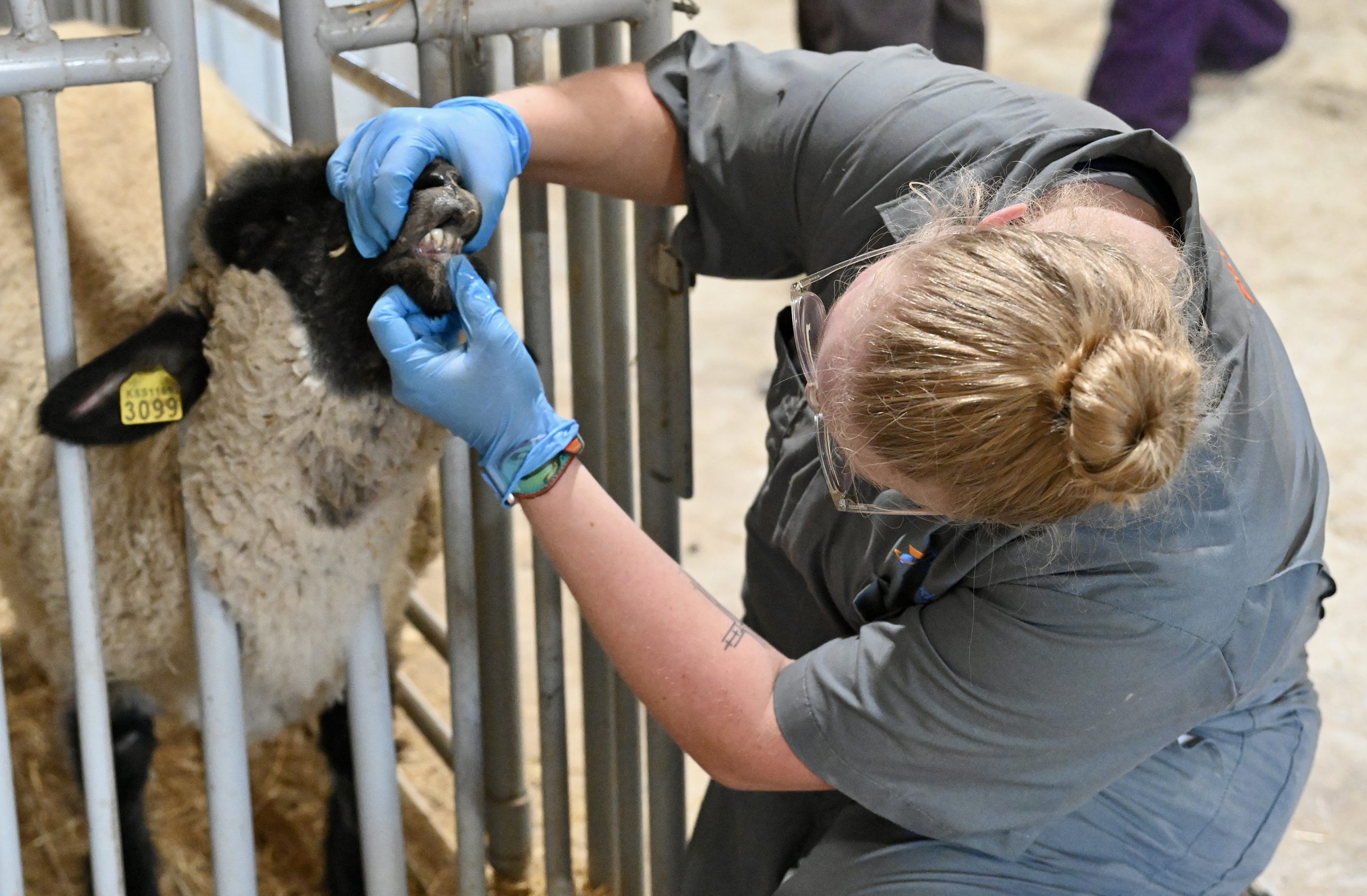
Checking its teeth.
Despite that smaller size, students and faculty have safety protocols to follow when handling smaller animals.
“The oral cavities of sheep and goats can have something called contagious eczema or Orf,” Mack said. “That can cause skin ulcerations. So, we go over that, and I’m like, ‘put your gloves on,’ because we’re going to look at their teeth. I spent a lot of time on zoonosis, which are diseases that transfer between humans and animals and understanding which ones you’re at risk for, and that’s part of our industry. As a veterinarian, it’s something I experience all the time, so we go through that.”
Mack teaches students how to care for a ewe in a cage, which involves other safety protocols.
“When they’re in the chute, I always tell people that it’s your arm versus the metal versus the animal,” she said. “When you put your arm through there, don’t put yourself in a position to get your arm or hand stuck, pinched, or broken. We just need to be conscious [while] working around the facilities because when you get to a large cattle hydraulic shoot, it’s less forgiving.”
In the end, the main purpose of the University Farm is to enable students to enter the agriculture industry successfully.
“It always applies directly [to them],” Mack said. “Either they’ll be using these skills in their daily life because they’re producers working side-by-side with other producers, or they know how it’s done. There’s always value, even if you’re selling seed to understanding what’s happening on that person’s operation, or having experience to understand how to move animals. You talk to people in that industry, and they end up helping producers and farmers do things, and having that background and understanding is key.”
More information can be found at https://www.fhsu.edu/agriculture/.