
By RORY MOORE
Tiger Media Network
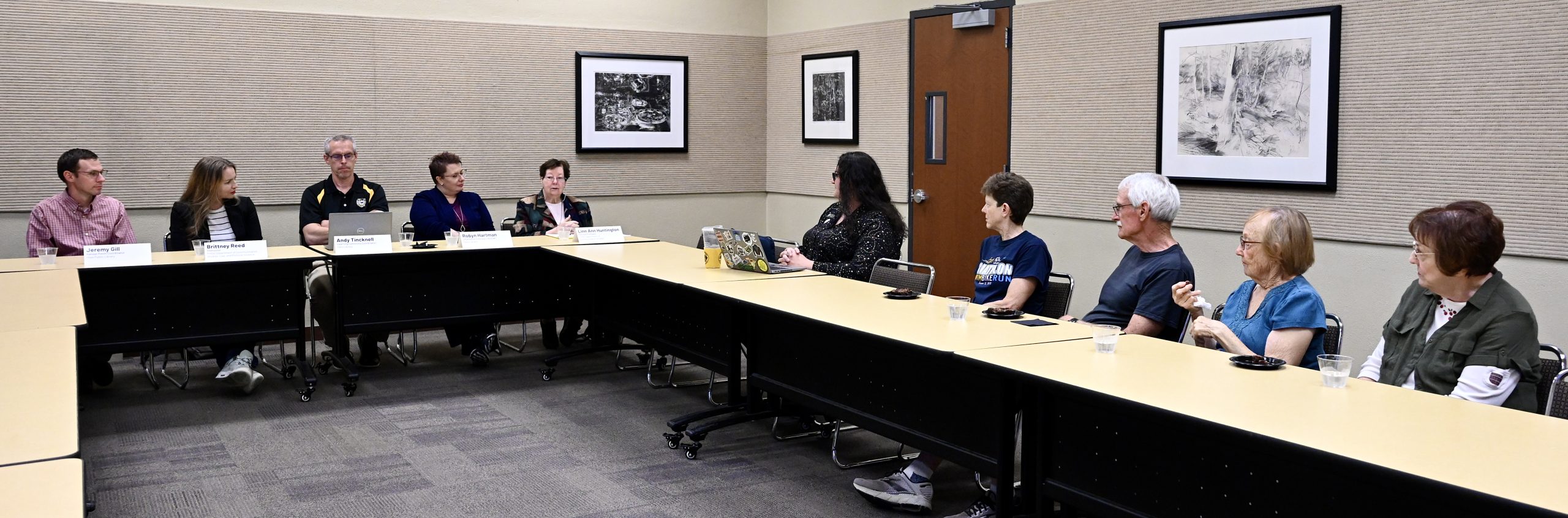
Fort Hays State University’s Tebo Library partnered with the Hays Public Library to host a panel discussion about misinformation and avoiding manipulation by news media for its “How-To-Series” on Thursday. The panel consisted of HPL Kansas Room Coordinator Jeremy Gill, Law and Political Science Professor Brittney Reed, Learning Coordinator Andy Tincknell, Information Literacy Librarian Robyn Hartman and retired Communications Studies Professor Linn Ann Huntington, and was moderated by Engagement Specialist Anna Towns.
The first question for the panel was about identifying real news from false, and Tincknell cited a study by the Association of Computing Machinery in his answer.
“It’s a 50/50 coin toss whether we can identify whether something is fake or real,” he said. “It’s getting tough, and it’s going to get tougher because the things we’re using to detect the fakes are lagging behind how fast the fakers are improving. So, that’s the bad news, but the good news is there are some strategies to look at. There are fact-checker sites, and there’s the old-school way to stop, take a breath, and figure this out.”
Hartman cited the SIFT method developed by digital literacy expert Mike Caulfield to evaluate the credibility and reliability of online information, which stands for Stop, Investigate the source, Find better coverage, and Trace the context.
“If it makes you stop and think about it, then that’s something to recognize,’is this even real?’ If you’re asking yourself that question, stop when you’re getting hit with a lot of information that is perhaps feeding on your emotions and building them up,” Hartman said. “A lot of stuff has been happening that if you keep reading about it, and if it doesn’t sound right in your mind, then that’s the clue that maybe it’s not.”
Reed expanded that point with the strategy of using consensual validation.
“That means we’re hearing the same thing from different sources,” she said. “If you’re seeing it from one source, take it with a grain of salt. You want to find several sources that are saying the same thing, particularly when it’s information that seems too crazy to be true.”
Huntington, a former journalist, believes that the time people take to find trustworthy sources depends on how eagerly they want truthful news.
“Journalists always had to engage in fact-finding efforts,” she said. “That means not just trusting one source, but getting confirmation from different sources. In the past, we’ve had gatekeepers, meaning journalists and editors who perform that function for us, and now, at least on the internet, there are no gatekeepers or government oversight of the internet at all. So, anybody can post anything they want, and it doesn’t have to be true. It can be a hoax. So, it depends on how badly people want to know the truth.”
Another issue discussed was people’s dependence on one source that fits their ideological stance.
“Many people are stuck in their own echo chambers,” Tincknell said. “They’re following the things they agree with, and getting out of that echo chamber, listening for other opinions, and giving them the time of day by not just neglecting them because they don’t necessarily agree with you, is an important thing to do.”
Reed also emphasized accountability in verifying news on the citizen level.
“One thing lost in our culture is we haven’t kept each other accountable,” she said. “When you say, ‘Is anybody going to take the time to research this?’ The thing is, we get this online disinhibition where we don’t have to face the consequences of posting something that was incorrect or maybe got people into a frenzy or caused an argument unless our peers keep us accountable.”
Gill stated that the primary role of educators and librarians is to train people to verify their course in the age of AI.
“In my role, I stand as [somewhat of] a reference librarian,” he said. “I teach a class on contemporary issues, and one thing we’re trying to teach students is to not always jump to AI. That’s not saying don’t ever use it, it’s telling people to stop and think about what you’re looking at. Some databases we use are user-generated, and they’re compiling information very quickly, and that’s nice on the surface level of wanting something fast, but not all of it is accurate, and people don’t realize that those things are harmful until it comes back on you. So, I try to tell people, ‘Don’t believe everything you hear.’”
Huntington singled out cable news as being a purveyor of misinformation.
“I think cable news is a misnomer,” she said. “It should be called cable opinion because the vast majority of what you find on cable news networks is opinion and commentary, which there’s nothing wrong with, but you need to know that’s what you’re getting when you tune into Fox News or MSNBC, or even ESPN. Facts are things that can be verified and proven, while opinions are things that cannot be proven one way of the other. These experts that cable news relies on to give us commentary, not all experts are created equal, so not all opinions are well researched.”