
By RORY MOORE
Tiger Media Network
Fort Hays State University’s Student Government Association hosted its annual Fall Open Forum in Cody Commons on Tuesday to update students on campus facilities and services, take questions, and address student concerns. The forum was moderated by SGA Legislative Affairs Director Grace McCord, while the panel consisted of Union Catering Company Owner Phillip Kuhn, Student Body President Jackson Sinsel, Residential Life Director RJ Schnack, Drug and Alcohol Counselor Bob Duffy and Faculty Senate President Matthew Clay.
The first question regarded the increase in lunch prices on campus and its impact on usage.
“We have to cover these costs with inflated prices we see,” Kuhn said. “There was a 4.6% increase in what we charge for the products. Those are all high-dollar items to begin with, so that’s why we did the increase. But we haven’t seen less usage. We’ve seen the same dollar amount come across on a weekly basis, and as far as dining dollars, there hasn’t been a decrease.”

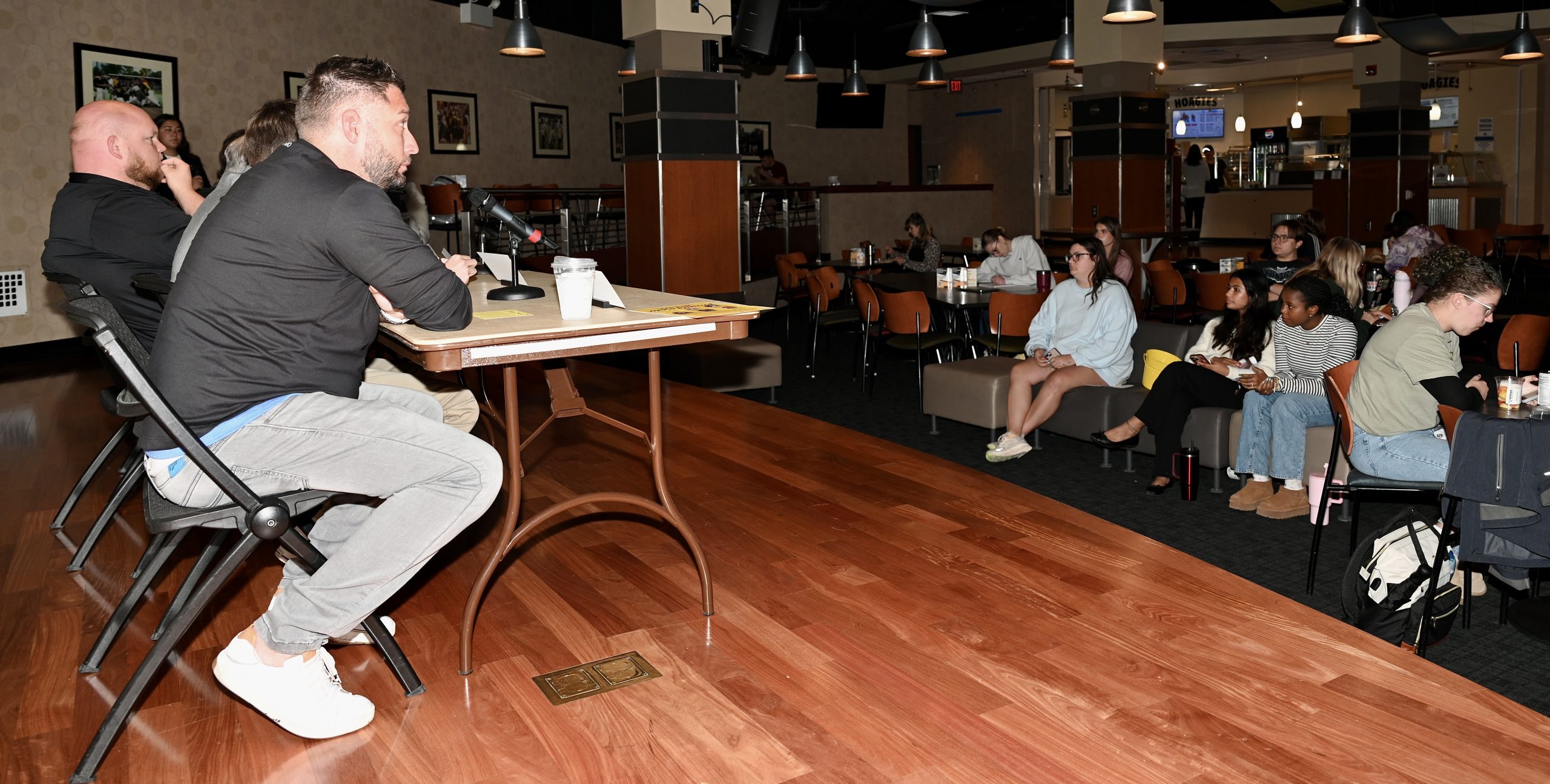
Grace McCord moderating Phillip Kuhn, Jackson Sinsel, RJ Schnack, Bob Duffy and Matthew Clay. 
Kuhn and Sinsel discussed lunch prices and bettering services for students. 
Clay talking about representing Fort Hays in the Board of Regents as the other panelists listen. 
Listening to concerns from students. 
McCord handed the mic to students to let them ask questions. 
Duffy discussing Health and Wellness Services and raising awareness for alcohol abuse. 
Student Body Vice President Breanna Schwien adding details to Sinsel’s updates on access to advisors.
Clay addressed his relationship with the Board of Regents, given his representation role for FHSU.
“The idea is that representatives from each of the region’s schools have a faculty member that’s supposed to give faculty [a] voice,” he said. “Sometimes, that’s input on policy and generating concerns. The board has the folks who vote and improve policies, but then they have professional staff who are higher ed professionals, and we work with them toward particular areas of concern.”
A focal point Clay has approached the board on is documenting faculty work across Kansas universities to ensure students’ needs are met.
“That’s to get ahead of some concerns of what might come out of the [Kansas] Legislature, where there are narratives about faculty not doing anything,” he said. “We tend to think that’s not true, but haven’t necessarily had the data to show that. So, we’ve been able to work with that policy, which is especially important from the Fort Hays perspective since our faculty experience is different from KU and K-State.”
Sinsel was asked about his actions to influence more partnerships between student organizations and academic transparency, a campaign promise he made upon his election.
“I think in terms of things we’ve been partnering with, it’s been higher this year than it has been previously,” he said. “My staff works with lots of groups across campus. Academic transparency hasn’t necessarily solved itself, but there have been steps toward it. I know there’s an outline of courses you could hypothetically take to get your degree, and I think that helps. But something we want to push for is that if those classes are only offered online, that should be known to the student if they’re enrolling here.”
He was also asked about strengthening Fort Hays’ academic advising program.
“I think our academic advisors, at least my own, are reaching out to students and trying to do everything they can,” Sinsel said. “They’re doing some things within Student Senate, so there are strides being made.”
One student asked about how the Faculty Senate addresses financial expectations of students concerning wages and tuition prices.
“Almost everything we do is tied to students,” Duffy said. “We wouldn’t be here without them, and then again, we try to work with staff too. When I was [Staff Senate] President two years ago, we were in a budget meeting, and I voted for the $10 raise for student employees. Without them, and students making $7.25 an hour, that wasn’t going to be sustainable with the vast increases. There’s that issue between, ‘Do we bring a separate company in as a consultant, or are these things that we can do?’ So, we always try to figure out what’s best and what’s going to keep the price down.”
Sinsel mentioned the renovations being made to various parts of campus and how federal and state funding have accelerated these projects.
“We got a lot of money from the state government to revitalize some of our old buildings on campus,” he said. “Fort Hays got $13 million from the Campus Restoration Act to fix facilities. Air conditioning’s going to be replaced; they’re looking to renovate Malloy and Sheridan [Halls]. There’s a whole bunch of stuff that’s going to be coming in the future, and it’s exciting.”
Duffy encouraged students to commit to the various activities on campus and connect with others to be aware of alcohol abuse.
“First thing I would do is communicate with each other,” he said. “Asking the questions: ‘Where are you going?’ ‘When are you going to be back?’ Getting rides for each other, going to the fitness center, taking advantage of all the activities that are involved with SGA. It’s never easier to get involved with things than it is while you’re in college.”
One of the last questions asked was about how students can receive help for roommate conflicts and mental health challenges.
“First thing for room mediation is talking with CAs (community assistants),” Schnack said. “They will talk to each student and both parties will do roommate agreements. If it doesn’t work from there, the next meeting is with the community director, and then they’ll try to hear something out. If they know somebody to switch in and out with, we’re more than happy to accommodate that switch.”
Duffy answered the mental health aspect, given his role at Health and Wellness Services.
“We work with students on how you have a difficult conversation,” he said. “Even if you’re not the one directly involved in a situation, you can talk to somebody and be supportive for them because we’re not always the first people they turn to. We know from research that students reach out to students first.”
Schnack added to Duffy’s point that students have a responsibility to help others gain a sense of belonging at Fort Hays, especially at Residential Life.
“Our biggest thing we see is two roommates not talking to each other,” he said. “Their groups talk to each other, but they won’t talk to each other until CAs get involved. Half the time though, some issues with meeting work. They just say, ‘Hey! Don’t use my toothbrush. Don’t eat my potato chips.’ They can just talk to each other, and that saves us some trouble.”
Other topics included were the implementation of eco-friendly to-go boxes for campus dining, student advocacy, and the effect of AI on education.