
BY RUBY DIAZ
Tiger Media Network
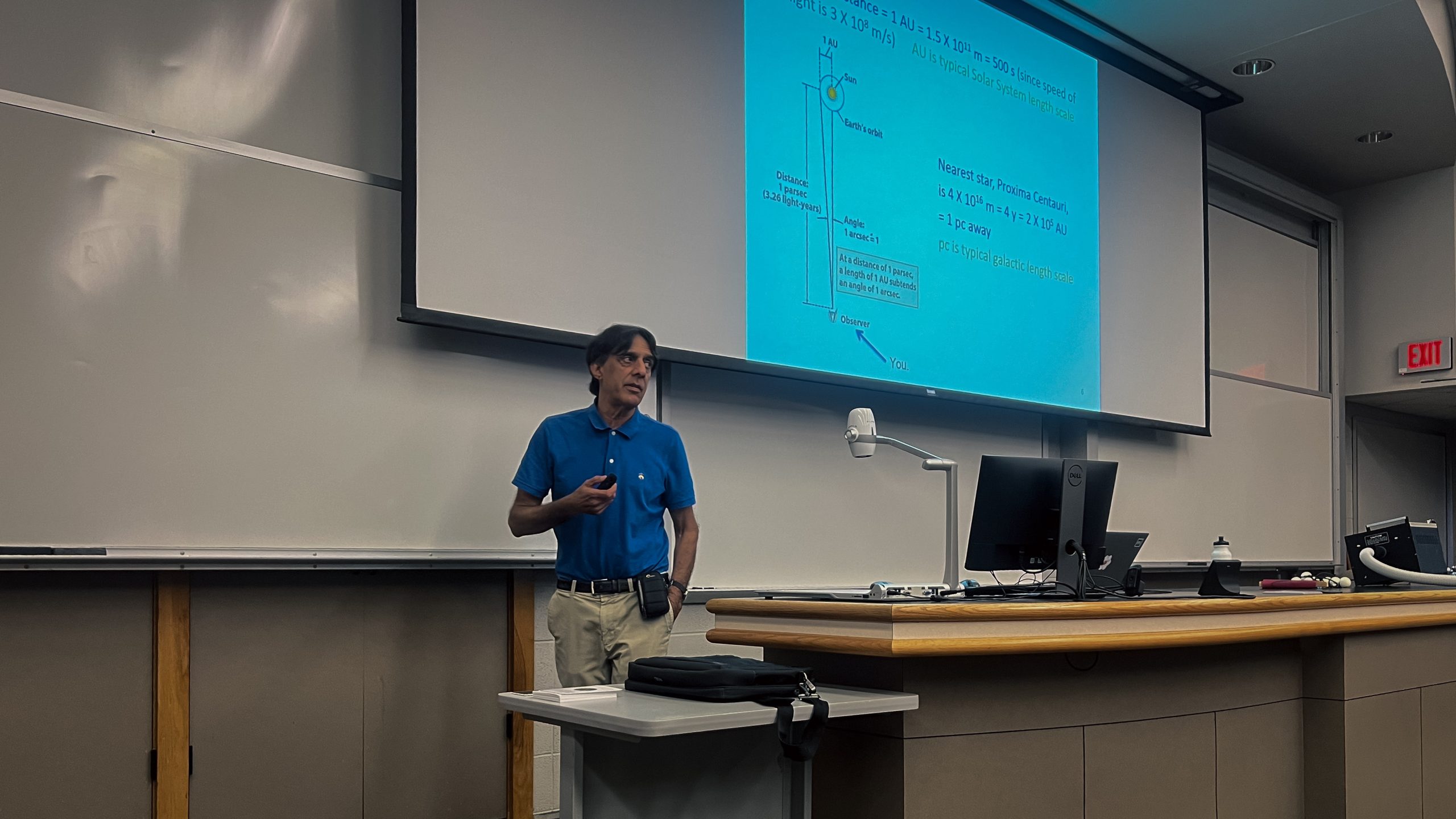
On Tuesday, Professor and Cosmologist Bharat Ratra from Kansas State University hosted a seminar on cosmology for physics students at Fort Hays State. Ratra said we only know about 5 percent of the universe. The other 95 percent, we have no idea what it is.
“Hair is the thinnest thing you can feel with your fingers. Hair is about 100 microns; if you have thin hair, it’s about 10 microns in diameter.” Ratra said to the audience to help explain relative size.
Ratra mentions there are many videos online to help make more sense of this phenomenon. One specific video he mentions is “The Powers of Ten,” a documentary film by Charles and Ray Eames, which explores relative sizes of things within the universe. The Museum of Natural History in New York has a more recent version of the video.
Ratra then discussed the distance within the universe, mentioning the star, Proxima Centauri, which is the closest star to our sun. It’s in the Alpha Centauri system and is 4.25 light-years away from Earth, and is the next closest star to us past the sun.
“Roughly 100 Earths cover the diameter of the sun. Roughly 750 million Einsteins cover the diameter of the sun,” Ratra says. “It takes four years for light from Proxima Centauri to reach us, while it takes 500 seconds for light from the sun to reach us.”
Ratra mentions that the microwave radiation in space is the same radiation that you use to cook with your microwave at home. It is also the same type of radiation that police use when they give you a speeding ticket.
“They send a signal that bounces off your car and gets reflected. It shows the incoming and outgoing wavelength,” he said. “They then use a formula to figure out how fast you’re moving relative to them.”
Throughout the semester, the FHSU Astronomy club will be hosting free observatory nights, weather permitting. This will allow attendants to look through telescopes and see all the stars. These events are open to both students and the public. Below is a link to see dates and times.