
By RORY MOORE
Tiger Media Network
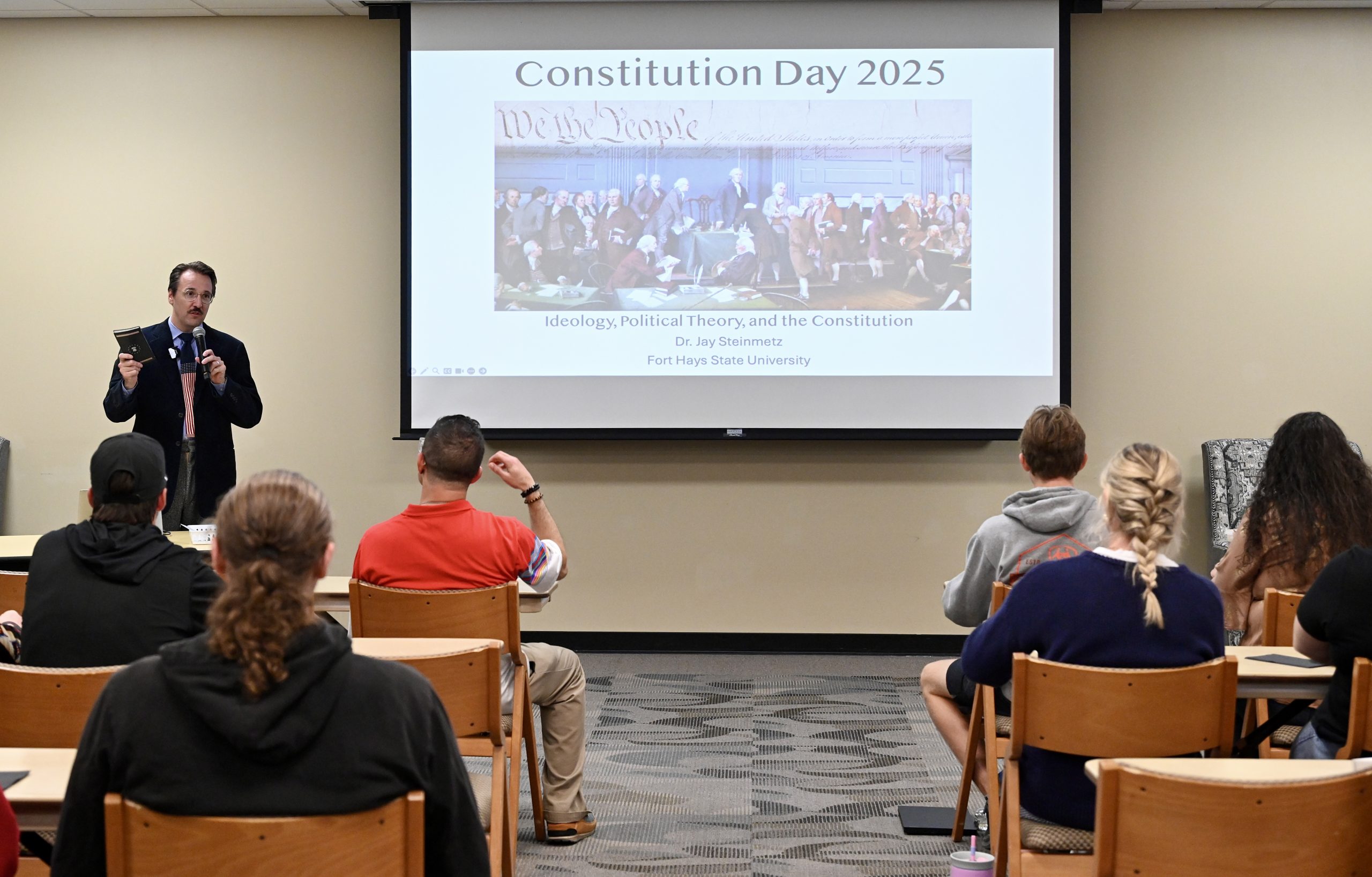
Fort Hays State University’s American Democracy Project hosted the 2025 Constitution Day Times Talk inside Stouffer Lounge in Memorial Union on Wednesday. Jay Steinmetz, an associate professor of Political Science, discussed the motivations and ideologies behind the United States Constitution and which political philosophy it reflects by today’s standards.

The 2025 Constitution Day Times Talk takes place in the Stouffer Lounge. 
Jay Steinmetz discusses the ideological basis of the U.S. Constitution and whether it is a liberal, conservative, republican, or progressive document. 
Steinmetz goes over the ideological factors that influenced the framers. 
Steinmetz notes how Classical Liberalism had an impact on the Framers when they wrote the Constitution. 
Discussing the Republican aspects. 
Steinmetz began his lecture by recounting how the Framers conceived the current Constitution based on ideals from Adam Smith and John Locke.
“We can say quite clearly they were aware of some deep flaws in the Articles of Confederation,” he said. “The Framers were motivated by protection of property and self-interest. Lockean principles have this idea that our own self-interest should be preserved or we should have certain aspects of limited government that allow for our interest to find root inside society and to be the basis of a prosperous society.”
Steinmetz went on to discuss how the Constitution can be a liberal document, which has been part of an ongoing debate over what the document is ideologically. He said Classical Liberalism is a rights-based individualist political theory that focuses on individuals and the notion of equality that exists amongst us.
“Thomas Hobbes saw the world in an atomistic way, and that means to see society as a collection of discrete individuals and to look upon society from an individual basis, not from a group or communal basis,” he said. “We are the authors of our destiny, and we should determine for ourselves what kind of society we want to live in.”
One of the earliest presidents whom Steinmetz attributed to the philosophy was Thomas Jefferson, saying Jefferson was kind of radical and Lockean in many ways and that he was an adherent of Classical Liberalism in ways that were stronger than most of the other founders.
“The principal idea of a Lockean state of nature is one in which self-interest can be utilized for the basis of a better society, and individual freedom is a good thing because it allows us to order our own affairs,” Steinmetz said. “Private property is the basis of our freedom, and it comes from the idea that we are born with a right of property over your own physical body, which you can externalize through labor.”
When discussing how some consider it a Republican document, Steinmetz noted the difference between Classical Republicanism and the conservative makeup of the Republican Party.
“This is ‘small-r’ Republicanism as a political theory,” he said. “Classical Republicanism is a communal political theory that advances the interests of the common good, not an individualistic political theory. Civic virtue and political engagement are key to Classical Republican values; it’s the highest purpose of human beings to engage in political life, and the highest virtue is civic virtue. It’s a theory that insists there is a responsibility on citizens to politically engage to advance the common good through engagement and civic virtue.”
He pointed out that framers incorporated liberal values in the Constitution despite the Classical Republican influence on Articles 1-7.
“The Framers, perhaps unwittingly, ushered in and created a very liberal and self-interested society in designing a constitutional republic,” Steinmetz said. “We’re a society that embraces industry, capitalism and private property protections.”
Regarding progressive aspects, Steinmetz emphasized its difference from Classical Liberalism and Republicanism, while also drawing some similarities to modern Progressivism.
“We look to the future to solve problems in the present, often regarding the past traditions as laden with discrimination and prejudice,” he said. “We can’t look to the past to solve these problems we have now. A progressive vision of politics is future-looking, to the horizon of possibilities. So, what can be regarded as progressive in the time of the Framers? Lockean ideas of equality, liberty and individual rights. Individuals have rights that protect them against government interference. The notion of capitalism was very progressive and radical in the early 1700s.”
When discussing the argument that the Constitution is a conservative document, Steinmetz noted a conservative ideal of looking to the past as opposed to the future, as progressivism does.
“Conservatives often look to the stability and reliability of tradition to conserve those traditions of the past in ways of life that came before,” he said. “There are other definitions of conservatism, like strong anti-revolutionary impulses. What can be regarded as conservative in the time of the Framers? Aristocratic, monarchical, and elitist government is a tradition of power that can be carried from generations.
“Traditionalism is inherently a conservative idea. The takeaway is that the Constitution is a conservative pullback from the more radical and progressive politics of the Revolutionary Period, but it can hardly be called a fully conservative document with its combining of the Bill of Rights and the seven Articles.”
Steinmetz stated that the Constitution is a liberal, republican, progressive, and conservative document.
“It reflects the general reality of compromises, not just in 1787 Philadelphia, but across the emerging American experiment and the complexity of American political development from the 1750s through the 1820s,” he said. “There are a series of complex compromises in shaping what this political community is. They do imply some degree of intentionality, and in erecting the Constitution and creating the American Republic, the Framers created the foundations of that development over time, so it might be more accurate to say that these impulses in shaping the constitutional moment were a complex amalgam of insights of worldviews and compromises.”