
By RORY MOORE
Tiger Media Network
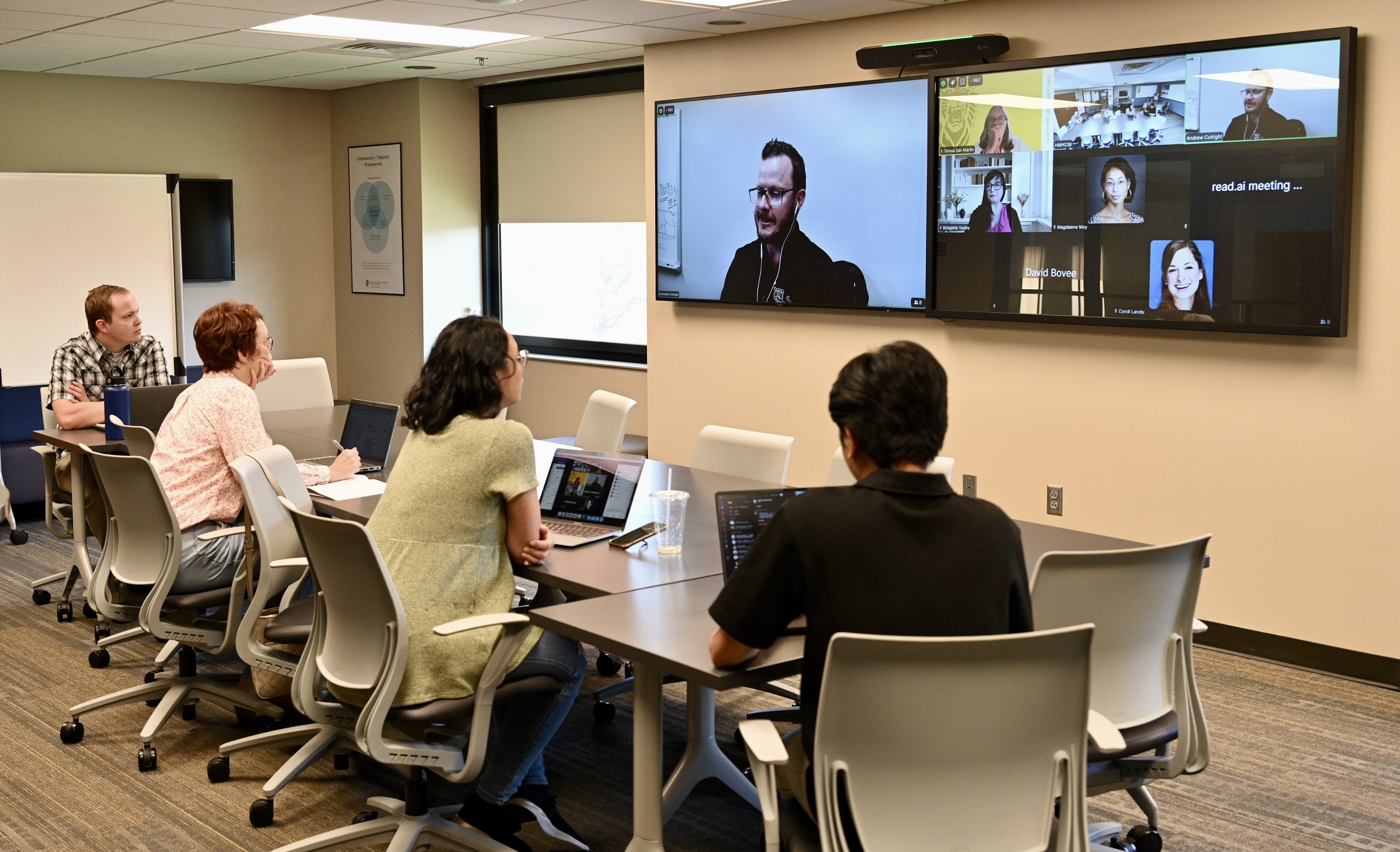
Fort Hays State University’s Teaching Innovation and Learning Technologies (TILT) staff hosted the AI Exchange Share and Learn workshop to meet with members of other departments inside Hammond Hall on Tuesday to discuss the rising value of AI skills in the job market and how it translates into academia. The meeting also addressed the concerns over the industries’ expectations of the technology and enabling faculty to adapt to its characteristics.
University Director of Assessment Andrew Cutright noted the increasing need for AI skills among businesses.
“It’s relevant to what we do with educating students,” he said. “AI skills are starting to prop up and expand in what people would consider non-traditional IT roles (Project Manager, Business Analyst, etc.). Roles that require these skills, on average, are paying about $18,000 more [than other roles]. Some of these traditional human skills, like the ability to communicate and emotional intelligence, are becoming more important as AI is coming about because you need some sort of truth filter to an extent.”
Instructional Technologist Magdalene Moy has led the initiative to guide faculty and students on the responsible use of AI as Chair of FHSU’s Generative AI Task Force.
“Each department is approaching it differently,” she said. “Their trajectory of professionals are using it in their field; social workers are using it for note-taking, but Applied Business has said the data for using it for CVs is not in their field. So, there’s a difference in what the expectation is coming out of the workforce.”
One student who joined the meeting, Seth Tharo Hour, reflected on the expectation of those skills as he graduates.
“I’m in the process of applying to a lot of jobs,” he said. “They didn’t specifically mention the usage of AI in the job description, and they’re mostly tech jobs. From talking to people working in those fields, they’re using it every day, and there’s a lot of AI jobs in the tech field, so I think it’s something that’s going to be big in the future. It’s already big now, and it’s getting better every year.”
Forsyth Library Coordinator Jennifer Sauer mentioned the lack of experience in AI use that some departments have.
“So many people haven’t done anything with it in a constructive way,” she said. “Maybe they’ve played or toyed with it, but they’ve not built their whole process around using it for a certain purpose that is core to their job.”
Moy emphasized how AI skills can differ between university and industry settings.
“Our faculty are faculty,” Moy said. “Seeing it in an industry is a different perspective. It’s just an observation that there’s a difference between when you work in an industry and can think about how it works into what you do every day versus how you teach students, but my concern is about using it inappropriately for class work.”
Despite that concern, Fort Hays’ use of Gray DI has been effective in analyzing third-party data about various programs, BLS data, unemployment projections, how many students enroll at the university, and how much tuition dollars are generated.
“It makes things that are complex to understand very easy to return complex answers that might take you a while to dig through,” Cutright said. “You can ask those questions in plain language, so it’s powerful to be able to take numerical information and provide not only what the numbers are, but to graph the information and show a trend over five years.”
Cutright noted how it helps students with their academics.
“You can upload everything about your course and have a chatbot they can work with,” he said. “It provides them with endless opportunities to engage with the content in the way that makes sense for them, and I think that’s powerful because now it’s not relegated to five or eight emails. It eliminates any sort of intimidation that may or may not occur with students, but they can ask the questions the way it makes sense to them as customized learning based on information you share as an instructor.”
More AI resources can be found at https://www.fhsu.edu/ai/ai-resources-students.