
Story by RORY MOORE Photos by PARKER NISBETH
Tiger Media Network
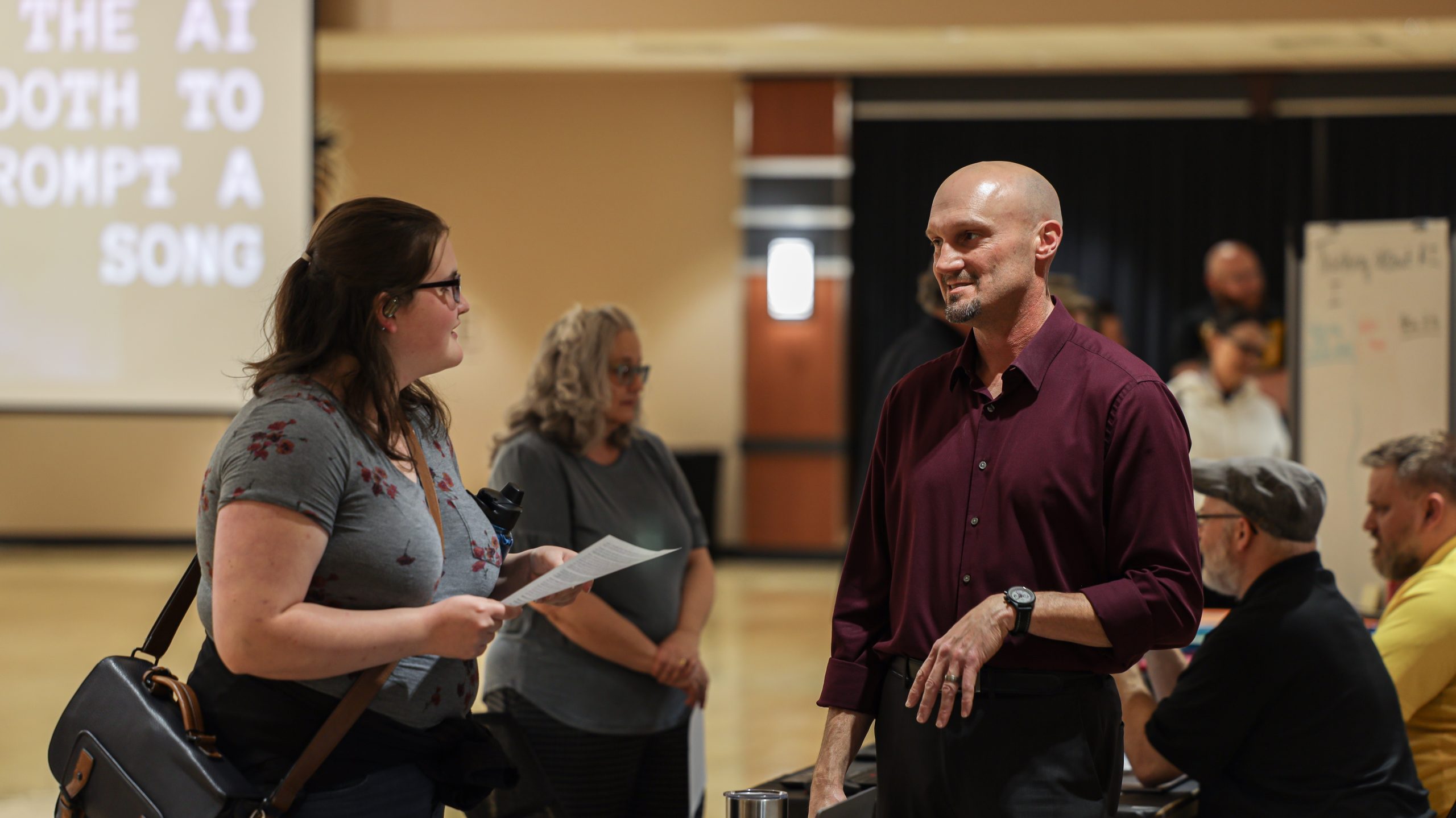
Fort Hays State University hosted an AI Institute and Fair on Tuesday inside the Memorial Union Ballroom to illustrate the future of Artificial Intelligence through discussions, demonstrations and interactive activities. The event began with workshops presenting AI’s role in education, research and industry. It concluded with an open fair featuring in-person booths. The event was also offered online.
Lisa Bell, FHSU Writing Center Director, staffed a booth that tasked attendees with identifying the difference between student and AI writing.
“We’re looking to gather ideas and future directions for university programs and research, and digging into AI to see what we can do on campus with the new technology,” she said. “For traditional academics, they’re starting to bring AI into the classroom to think about how to use it to research. For less traditional academics like marketing, they’ve started integrating AI into their programs more heavily. So, the business department, computer science, they’re relying far more heavily on AI.”
Bell sees much potential in the technology when used responsibly.
“It will be a net benefit once everything gets ironed out and AI is accepted as a commonplace technology,” she said. “We [will] understand what it can and cannot do and how to use it appropriately and ethically.”


AI has become reliable not only in research but also in preparing for job interviews.
“We’ve used a platform called Big Interview,” FHSU Career Advisor Graham Dixon said. “It helps students with the interviewing process by being able to learn about the types of interview questions they might be asked. Recently, they came out with the Resume AI tool that we started demoing this summer and working with the Applied Business Studies program.”
Dixon applauds AI for assisting students with building their resumes.
“It can go two different ways,” he said. “Some students can go in, and it can review their resume, check out the formatting, and make sure that it’s consistent. They also have an ATS fit where students can put in a job description and have those keywords, see what’s being picked up, and what they need to add to their resume. We’ve been working with the Business Communications department to implement it into their classes so instructors can have different assignments for specific industries.”
He understands the concern of plagiarism with AI but believes it can be addressed.
“It’s just another set of eyes for students,” Dixon said. “A lot of them like to have that human touch to make sure their resumes look great. I wouldn’t consider this cheating going into the workforce. It’s utilizing that tool and making sure that those keywords match up. It’s also the critical thinking portion of ‘Is this a good fit for my job description? Does it sound okay?’ It’s less about relying on it and more about utilizing it as a tool.”
Andy Tincknell, coordinator for the FHSU Learning Commons, wanted to show that there is more to AI than plagiarism in writing.
“There are multimedia tools that can have advantages and disadvantages,” he said. “It has made mundane tasks much faster. It used to be that when you wanted to delete something from an image, you would need to trace around it, take little samples of things, and paste over it. Now, all you have to do is make a rough outline around it and say to remove it, and it’s gone.”
Tincknell was referring to AI’s advancements in apps like Adobe Photoshop.
“It’s made routine tasks faster,” he said. “You can insert things without having to go out and find them. You just say, ‘Put a cat here.’ It will find a cat from other images in the cloud, and it will put in a cat. It will usually give you several generations of that, and you can choose the one you like the best or regenerate.”
Unlike Bell and Dixon, he sees AI as a negative in academics due to students’ dependence on it.
“We are trying to get people to think and do things for themselves,” Tincknell said. “It’s harder to learn how to do things the hard way. For writing, you should know how to write something so you can identify good writing or bad writing, and it’s the same for media. You should be able to identify good and bad, so you need to know how to create things from basic building blocks.”
He also sees how AI can potentially disenfranchise people.
“There are graphic designers who are afraid of their jobs being gone,” Tinckell said. “There are so many things the average Joe on the street can do now that they couldn’t before that they had to hire somebody for.”
Nevertheless, Tincknell comprehends the positive aspects of AI.
“It’s not something that’s going away,” he said. “We have to learn to embrace it to understand how it’s beneficial and why there are issues with it. You’ve got to teach the good and bad side of it. Students are going to be using these tools, so they should know how to use them ethically to do their jobs well.”