
By RORY MOORE
Tiger Media Network
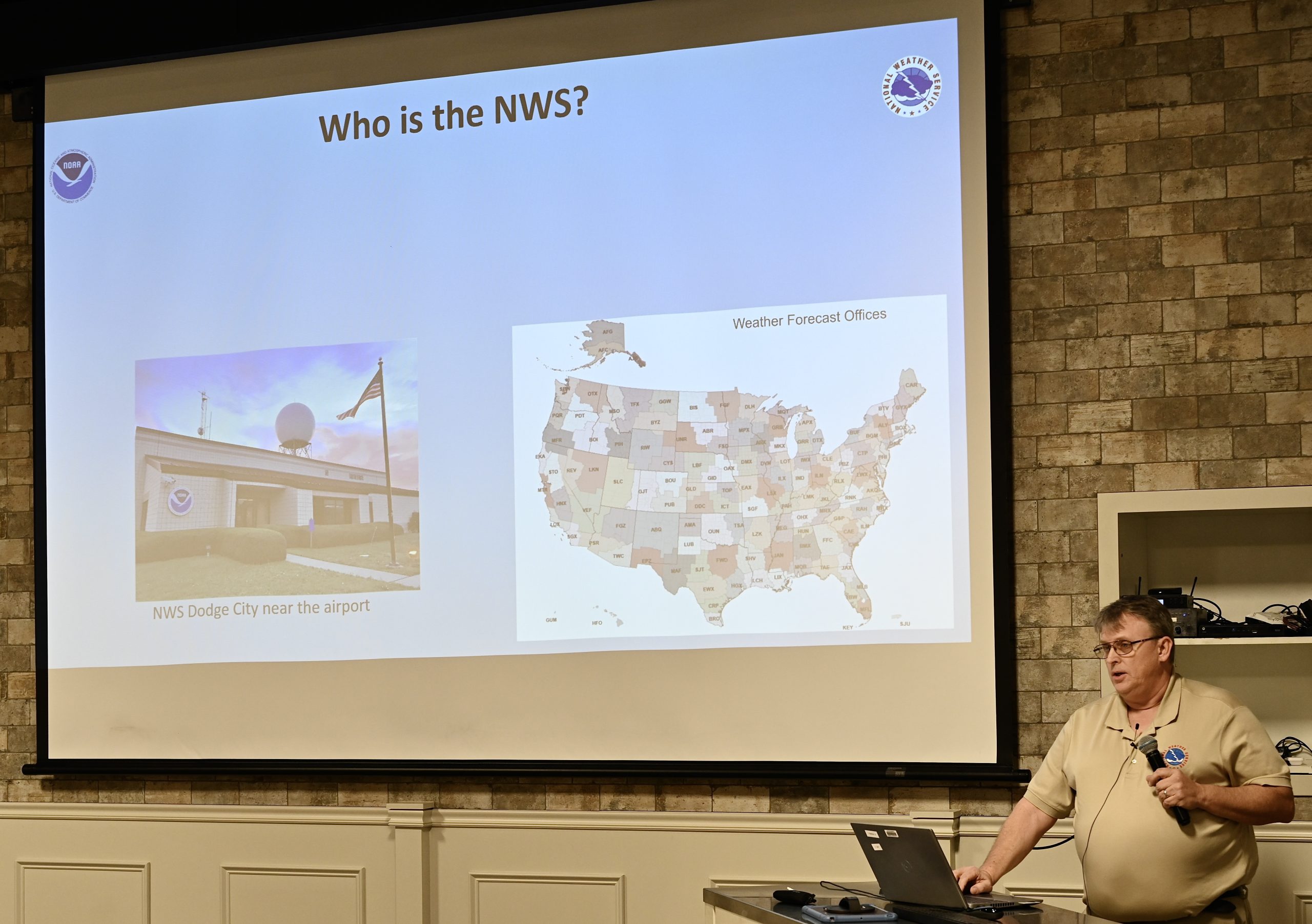
The FHSU Science and Mathematics Education Institute hosted the 139th Science Cafe inside the Venue at Thirsty’s on Monday. The presentation featured a slideshow led by meteorologist Marc Russell, who taught the basics of the National Weather Service, how it serves people around the nation, and how to take safety measures in severe weather.

The FHSU Science and Mathematics Education Institute hosts a the 139th Science Cafe inside the Venue at Thirsty’s. 
Meteorologist Marc Russell presents a slide show detailing who the National Weather Service is and what it does. 
Russell has worked for the NWS for 45 years. 
Russell displays a map of costly natural disasters across the country in 2024. 
Positions at the NWS Dodge City office are listed. 
Russell shows a slide depicting where wind gusts over 74 mph happen with the most being in Western Kansas.
Russell, a veteran meteorologist of 45 years, began his lecture on what the NWS is.
“We’re part of the U.S. Department of Commerce,” he said. “NOAA is our parent bureau, and there are 122 of our offices. Dodge City being one of those in Kansas.”
He laid out the composition of staff at the Dodge City office.
“There’s 16 full-time meteorologists,” Russell said. “There’s 10 of us that are meteorologists. The others are electronic technicians who work on the radar, and they fix the visibility sensors. Our mission statement is that the National Weather Service provides weather, hydraulic, climate forecasts, and warnings for the United States and its territories for the protection of life and property.”
The biggest responsibility of the NWS, as Russell noted, is to provide a safety net for citizens and government officials.
“Our data and products form a national information database and infrastructure which can be used for public governmental agencies, the private sector, the public and local communities,” he said. “We exist so that there’s not chaos. There’s got to be an official voice for climate information records and the warnings that go out. So, that’s why we’re charged with that by Congress.”
Russell displayed a map of areas around the country where weather-related disasters happened, some of which sustained millions of dollars in damage.
“These big costs events are looked at closely,” he said. “We keep a record of the data to send it forward so that insurance companies can have it and FEMA and provide recovery.”
He listed many of the tools that the NWS uses to track cells.
“We have the Radar 88-D,” Russell said. “That stands for 1988 because that’s when many of our programs were put in. We also have high-speed computers since a lot of computing is done in our office. We have whole rooms which are big green frames. Our radars will take data from the environment and then it moves it out to the satellite dishes for the world to get, and it comes into our office where it gets post-processed.”
The weather balloon is used by the Dodge City office twice a day.
“The weather balloon goes up at about six in the morning and six at night,” Russell said. “We fill it with hydrogen and put a little radio on it along with a parachute. We let it go, it floats up, and it falls back down. It takes the temperature, pressure and humidity data all the way up until it falls down.”
Russell pointed out that meteorologists work for other industries besides the NWS.
“Careers are a lot more wide than just the government or weather service,” he said. “There are a lot of meteorologists who end up being able to work for transportation companies like FedEx and UPS. They have some of their own forecasting going on because they want to integrate education, government and weather service there.”
He stressed that the NWS is looking for recruits willing to do the job.
“If you’re looking to get into it, things that you want to do is shadow people,” Russell said. “Show willingness and eagerness, get some experience, get research projects, and volunteer. That’s how I got in.”