
Story by CIARA CEBALLOS-GUTIERREZ Photos by BREANNA HOY Video by NDEYE NGONE NDIAYE
Tiger Media Network
Fort Hays State University students had the opportunity to explore challenging literature and learn more about censorship during Banned Books Week last week. The Tebo Library hosted a number of activities designed to raise awareness about book bans and intellectual freedom. One of the main events was an augmented reality bookshelf in the library.
“We worked with the Institute for New Media Studies, which is housed in the lower level [of Tebo Library], and made an augmented reality bookshelf,” said Tebo Library engagement specialist Anna Towns. “When you look through the tablet, you can see those banned books and learn a little bit more about them, what the book’s about, and why it was banned.”

Some of the Top 11 most challenged books of 2023 
More books that are on display for the Top 11 challenged books of 2023 
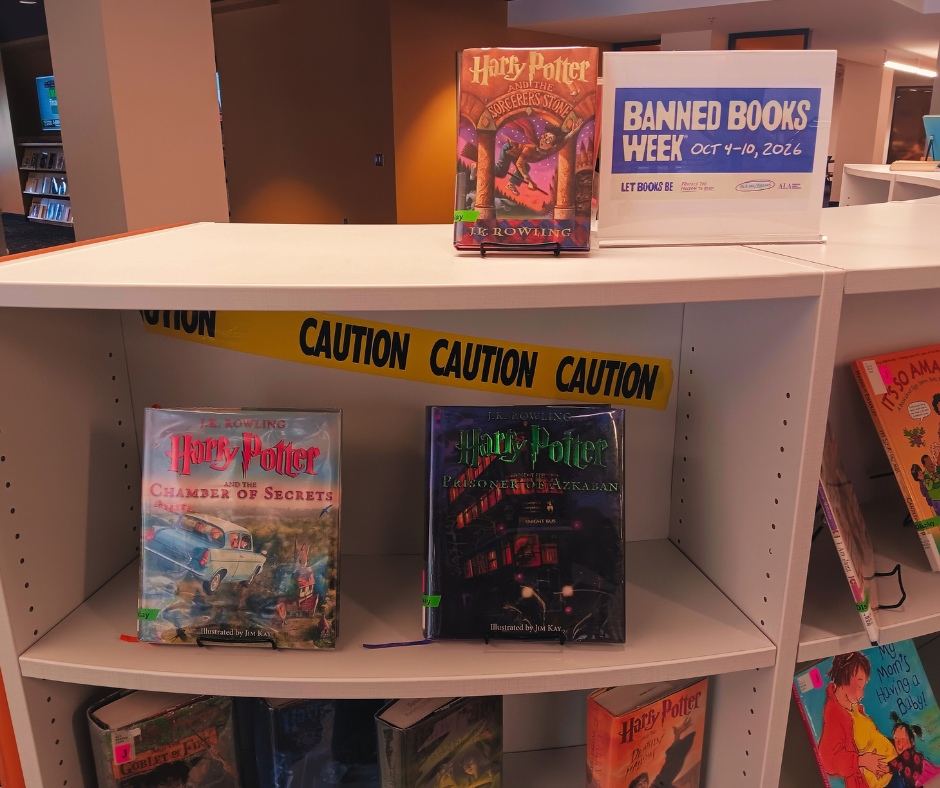
Banned books that include Harry Potter were featured on the bookshelf 
More banned books that feature a chart of censorship by numbers 
The Augmented Reality Bookshelf set up in Tebo Library 
The display of banned books located in the Tebo Library 
The display look without the Augmented Reality 
Another look of the banned books display 
Harry Potter is a challenged banned book 
How the display looks through the Augmented Reality
Other events Tebo library hosted included banned-book button-making, displays of banned books in the library, interactive flip books with facts and statistics about banned books, and the bookmobile, which had displays of banned books for students to check out.
Although book banning is often associated with public and school libraries, censorship can also affect higher education. According to Towns, book restrictions in colleges and universities often involve what professors are permitted to teach.
“Only 3% of those bans are in higher education, but they do happen,” Towns said. “More often than not, it’s curriculum-based. So it’s some entity, whether it’s your state legislature or a board of your school, that is banning certain things from use in curriculum. So they might say you can’t teach a certain topic or [say] you can’t teach a certain book, and then that would be a form of book banning.”
Beyond limiting access to certain books, censorship can also affect students’ exposure to different perspectives in the classroom. English professor Cheryl Duffy explains that reading challenging material can help students develop critical thinking skills and consider viewpoints different from their own.
“Any reading that you do challenges your preconceived thinking,” Duffy said. “But if you never think about those other viewpoints, because you have never been exposed to them, then your critical thinking is certainly going to be limited.”

Student learning how to make button for the first time 
Student trying to make decision on which kind of button to make 
Eden Staples enjoying the button making event 
Students learning about banned books 
Issac Haggart taking time out of his day to make buttons 
Tiger trying out the button making machine 
Tebo library’s table set up for Banned Books Button Making 
Anna Towns helping students make buttons 
Student enjoying button making during lunch time 
Student stops by table to make a button for banned books 
Student enjoying the button making machine 
Tiger loving the good options for button making 
Tigers seeing how much fun button making can be 
Student enjoying learning more about banned books 
Anna Towns tabling for the Banned Books Button making
Students can also benefit from reading books that explore experiences and perspectives different from their own. Lily Nash, an FHSU senior and English major, said access to a variety of viewpoints helps students better understand the world around them.
“Students are supposed to seek knowledge and different perspectives of that knowledge and the way to become a culturally mindful person is to have different perspectives of what has happened in the world around you,” Nash said.
For Nash, defending access to books also means being willing to listen to people who hold different opinions. She said conversations about challenged books should focus on understanding different perspectives rather than dismissing them.”
“ I truly do not believe that you can debate from your own viewpoint until you understand somebody else’s,” Nash said.